
Why Palmview Utility Installations Rely on Expert Flagging Services for Safe, Uninterrupted Traffic Flow — Comprehensive Guide
Utility work in Palmview hits differently than in most South Texas communities. The combination of narrow residential streets, rapid population growth that has outpaced road capacity, and the proximity of new utility corridors to high-speed arterial roads creates a unique operational puzzle. Expert flagging services are the linchpin that keeps traffic moving safely through these work zones — not just by holding a stop sign, but by executing a carefully calibrated system of communication, timing, and regulatory compliance that prevents accidents and prevents gridlock from compounding the daily commute.
What Makes Palmview Utility Installations Uniquely Challenging for Traffic Flow?
Palmview has experienced explosive residential development over the past decade, with neighborhoods like Palmview North and the area around La Paloma Park seeing new subdivisions and utility hookups that demand underground work on roads never designed for this volume of disruption. The challenges are not theoretical — we deal with them every week.
Rapid Population Growth Increasing Road Congestion and Utility Demand
Palmview’s population has grown by more than 35% since 2010, according to U.S. Census estimates. More homes mean more water, sewer, and natural gas connections — all of which require excavation across or alongside roadways. The same roads that carried light local traffic a decade ago now handle commuter volumes bound for McAllen and Mission, making any lane closure a potential bottleneck.
Narrow Residential Streets with Limited Detour Alternatives
Neighborhoods like the area surrounding Dove Avenue and South Palmview Drive feature streets with minimal shoulder width — often no more than 28 to 30 feet from curb to curb. When a utility trench occupies one lane, there is no room for a bypass lane. Flaggers must manage alternating single-lane traffic through a corridor where sight distances are often obstructed by parked vehicles and mature landscaping.
Proximity of Underground Utilities to Major Arterial Roads
Many new utility installations run parallel to or cross beneath Expressway 83, the region’s primary east-west corridor. Working within the right-of-way of a road where speeds reach 65 mph demands flagging protocols that go far beyond basic hand signaling. One misjudgment at those speeds is catastrophic.
High Pedestrian and Cyclist Activity Near School Zones
Palmview has several schools — including Palmview Elementary and Palmview High School — where student foot traffic peaks during the same morning and afternoon windows that utility crews need for mobilization. Flaggers in these zones must manage not only vehicular traffic but also children on bikes, parents pushing strollers, and school buses navigating tight work zone tapers.
Seasonal Weather Patterns Affecting Visibility and Road Conditions
South Texas monsoon season from June through September brings sudden, intense downpours that reduce visibility and turn unpaved shoulders into mud pits. Flaggers must contend with sun glare in the early morning and low-angle evening light that can blind oncoming drivers approaching a work zone from the west. Our crews rotate positioning based on sun angle — a detail most people never think about but one that prevents accidents every shift.
How Do Expert Flagging Services Prevent Accidents During Utility Work in Palmview?
Flagging is not a low-skill entry-level job — it is a high-stakes communication role that requires certification, situational awareness, and the ability to make split-second decisions under traffic pressure. We train our flaggers to anticipate problems before they develop.
Continuous Visual Communication Between Flaggers and Equipment Operators
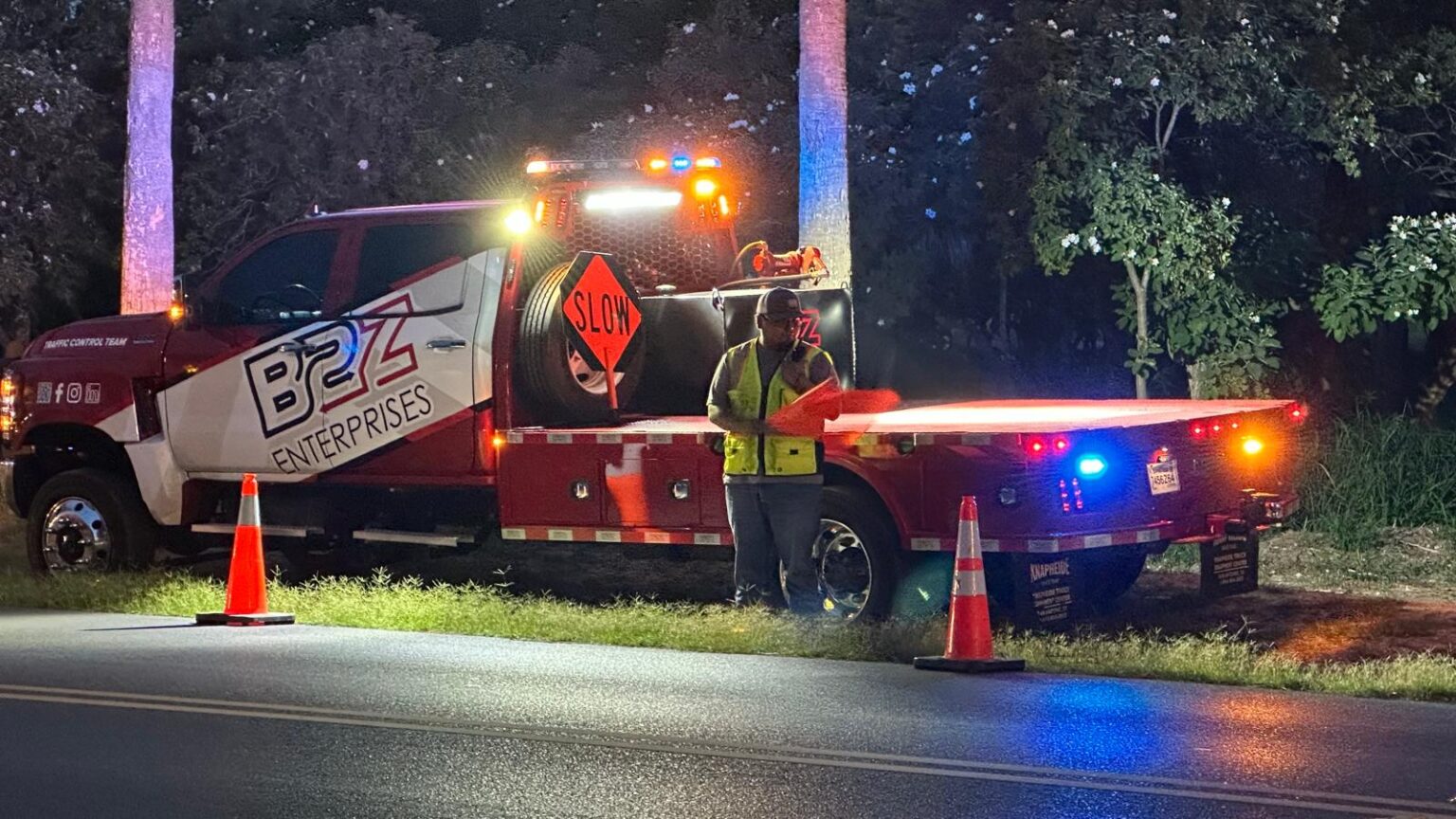
Every flagger on a B2Z Enterprises crew maintains eye contact with the excavator operator and dump truck drivers at all times. If an operator cannot see the flagger, work stops until line of sight is reestablished. This is not optional — it is built into our daily pre-shift safety briefings and aligns with OSHA Standard 1926 Subpart G, which governs signaling and barricade use at construction sites.
Proper Hand Signaling and Paddle Usage Compliant with MUTCD Standards
All B2Z flaggers are trained to use STOP/SLOW paddles according to the exact specifications in Part 6 of the Manual on Uniform Traffic Control Devices (MUTCD) — including the mandatory 48-inch minimum paddle size, the correct reflective sheeting grade, and the proper arm positions for directing traffic through a work zone. We do not allow improvised hand gestures; every movement follows a standardized code that drivers across Texas recognize.
Pre-Shift Safety Briefings Addressing Specific Palmview Road Hazards
Every morning before a utility project starts, our lead flagger conducts a briefing covering the day’s specific hazards: known potholes on the detour route, school bus pickup times near the work zone, scheduled trash collection that could block flagger positioning, and weather radar updates. This level of granular planning is what separates professional crews from day-laborers who show up unprepared.
Real-Time Coordination with Local Law Enforcement for Emergency Access
When a utility installation blocks a road in Palmview, we establish a direct radio link with the Palmview Police Department dispatch. If an emergency vehicle needs to pass through the work zone, the flagger team can clear the lane in under 30 seconds. We also coordinate fire lane access near the Palmview Fire Department station — no utility work ever blocks their primary egress route without an approved alternative.
Defensive Positioning of Flaggers to Maintain Clear Sight Lines
Flaggers are positioned based on stopping distance calculations, not convenience. On a road with a 35 mph speed limit, the standard stopping distance is approximately 120 feet. Our flaggers stand at least that distance ahead of the work zone entrance so that drivers have adequate time to react to their signals. On curved roads near Los Ebanos Road, we add extra advance flagger positions because sight lines are reduced by vegetation and terrain.
What Are the Key Components of a Temporary Traffic Control Plan (TTCP) for Palmview Utility Projects?
A Temporary Traffic Control Plan is not a generic document — it is a site-specific engineering blueprint that accounts for traffic volumes, road geometry, pedestrian patterns, and regulatory requirements. Every utility project in Palmview gets its own TTCP, reviewed and stamped by a qualified professional engineer.
Site-Specific Traffic Volume Data from Peak and Off-Peak Hours
We collect actual traffic counts — not estimates — for every project location. On Business 83 through central Palmview, peak-hour volumes exceed 1,200 vehicles per hour in each direction. Our TTCPs are designed to accommodate those volumes with minimal delay, using timing cycles that keep wait times under two minutes during peak periods.
Detour Routing That Minimizes Impact on Palmview’s Business Districts
Closing a lane in front of a retail plaza on West Expressway 83 can cost businesses thousands in lost foot traffic. Our TTCPs evaluate alternative detour routes that redirect traffic around — not through — commercial corridors. When detours are unavoidable, we install temporary signage directing customers to alternative entrances and parking areas.
Advanced Warning Signs Placed at Mandated Distances Before Work Zones
The MUTCD specifies exact advance warning sign distances based on posted speed limits. On Expressway 83 where speeds reach 65 mph, signs must be placed 1,500 feet before the work zone. On residential streets near Palmview Park where speeds are 25 mph, the distance reduces to 200 feet. We measure every placement with a measuring wheel — no approximations.
Tapering Patterns Designed for Palmview’s Typical Speed Limits (25–45 mph)
The taper length — the transition zone where traffic merges from two lanes into one — is calculated using the formula: taper length (feet) = speed limit (mph) × width of lane closure (feet). For a 30 mph road with a 12-foot lane closure, that works out to 360 feet of taper. Our crews set up and measure every taper to these specifications, using channelizing devices spaced at intervals that prevent vehicles from cutting through the buffer zone.
Night Work Provisions with Reflective Markings and Illuminated Channelizing Devices
Some utility installations in Palmview are scheduled for overnight hours to minimize traffic disruption. Our night work TTCPs include Type C reflective sheeting on all signs, illuminated channelizing drums with LED lights, and flaggers wearing high-visibility Class 3 vests with reflective striping that meets ANSI 107-2020 standards. Vehicle-mounted arrow boards are placed at the taper entrance to provide early warning.
How Does B2Z Enterprises’ Flagging Services Ensure Minimal Disruption During Lane Closures?
Our philosophy is simple: the work zone should cause the least possible inconvenience to the people who live and drive in Palmview every day. That means aggressive scheduling, dynamic traffic management, and fast restoration.
Rolling Lane Closures Scheduled During Lowest Traffic Periods (9am–3pm, After 7pm)
We never close lanes during peak commuter hours on Palmview’s major roads unless absolutely required by emergency utility repairs. Standard daytime utility work is scheduled between 9:00 AM and 3:00 PM, when school traffic has subsided and before the evening commute begins. For projects on Expressway 83, we often shift to night work starting at 7:00 PM and ending before 5:30 AM — the window when traffic volumes drop by more than 60%.
Two-Way Traffic Flagging Protocols to Prevent Long Wait Times
In alternating one-lane zones, we use radio-coordinated flagger teams at both ends of the work zone. Our standard cycle limits wait times to three minutes maximum — if a queue builds longer than that, we adjust the cycle or open the lane temporarily to clear the backlog. This keeps frustration low and reduces the risk of drivers attempting dangerous passes around the work zone.
Dynamic Diversion Strategies Using Portable Variable Message Signs
When unexpected congestion develops — from a crash upstream or a special event in Palmview — our crews can deploy portable variable message signs that direct drivers to alternative routes in real time. These signs are pre-programmed with multiple messages that we can activate from a handheld controller, allowing us to adapt to changing conditions without sending a crew member to physically replace sign panels.
Real-Time Communication with Local Traffic Management Centers
We maintain direct communication with the Hidalgo County Regional Mobility Authority’s traffic management center. When we close a lane on a road that feeds into the region’s signal network, they can adjust signal timing on adjacent intersections to accommodate the diverted traffic flow. This coordination prevents the kind of cascading gridlock that occurs when lane closures catch traffic engineers by surprise.
Post-Work Asphalt Restoration to Eliminate Bumps or Uneven Surfaces
When a utility trench is backfilled and paved, we inspect the restoration before removing the last traffic control device. Any bump, dip, or uneven pavement edge that could cause a driver to swerve or lose control results in immediate rework. We do not sign off on a project until the riding surface is smooth and safe at the posted speed limit.
What Safety Standards Do Palmview Work Zones Follow to Comply with Regulations?
Compliance is not a burden — it is a commitment. Every work zone we operate in Palmview meets or exceeds the requirements of federal, state, and local regulations.
Full Adherence to Texas MUTCD and Palmview Municipal Ordinances
The Texas MUTCD, which incorporates federal standards with state-specific amendments, is our operational bible. Palmview also has municipal ordinances governing lane closure permits, advance notification requirements for nearby residents, and restrictions on work during special events. Our permit coordinators track every local requirement and include them in the project plan before the first cone is placed.
Use of OSHA-Approved Personal Protective Equipment (PPE) by All Flaggers
Every B2Z flagger wears hard hats, safety vests with ANSI Class 3 reflective material, work boots with slip-resistant soles, and gloves. In rainy conditions — common during Palmview’s monsoon season — we add rain gear with reflective striping so visibility is maintained even in downpours. PPE is inspected before every shift; damaged equipment is replaced immediately, not at the end of the week.
Daily Inspection of Temporary Traffic Control Devices for Damage
Traffic cones, drums, barricades, and signs take abuse from sun exposure, vehicle strikes, and wind. Our crews perform a full inspection of every device at the start and end of each shift. Cones that have faded to the point of reduced visibility are pulled from service. Signs with cracked faces or peeling reflective sheeting are replaced. This level of attention might seem minor, but a single faded sign at the wrong location can cause a driver to miss a warning and enter a work zone at full speed.
Incident Response Protocols Specific to Palmview Fire and EMS Routes
We maintain maps of all emergency response routes in Palmview, including fire station egress paths and ambulance access corridors. If a work zone falls within 500 feet of one of these routes, we establish a direct communication channel with the affected station. In the event of an emergency call, our flaggers can clear the zone and allow emergency apparatus to pass within seconds — without waiting for radio confirmation.
Documentation of Traffic Control Setups for Liability and Audit Purposes
Every B2Z work zone is photographed and documented with time-stamped records showing the placement of signs, cones, and flagger positions. This documentation is maintained for the duration of the project and for at least three years afterward. It protects both our clients and our company in the event of an incident, and it provides a detailed record that can be reviewed to improve future deployments.
Why Is Flagging Critical for Uninterrupted Traffic Flow During Highway Maintenance in Palmview?
Highway maintenance on Expressway 83 and other limited-access roads in Palmview presents flagging challenges that are entirely different from those on residential streets. Speeds are higher, traffic volumes are greater, and the consequences of a mistake are far more severe.
High-Speed Arterial Roads Like Expressway 83 Require Precise Flagger Positioning
On Expressway 83, flaggers are positioned at distances calculated to give drivers traveling at 65 mph adequate time to react. That means the advance warning zone begins more than a quarter-mile before the work zone, with multiple sign placements that progressively inform drivers of the approaching lane closure. Flagger positions themselves are located beyond the taper, not within it, so that drivers who have already merged are not distracted by a flagger standing in their path.
Prevention of Secondary Accidents from Sudden Braking or Rubbernecking
Rubbernecking — drivers slowing down to look at work activity — is a leading cause of rear-end collisions in highway work zones. Our flagging protocols include positioning strategies that minimize visible worker movement from the travel lane and the use of portable screening devices that block the view of the work area. When drivers cannot see what is happening, they keep their eyes on the road ahead and maintain steady speeds.
Coordination with Nearby Construction Projects to Avoid Simultaneous Lane Closures
Palmview often has multiple construction and utility projects active simultaneously along the Expressway 83 corridor. We coordinate with other contractors and the Texas Department of Transportation to ensure that lane closures on adjacent segments do not occur at the same time. Staggering closures prevents the kind of compounded congestion that turns a manageable delay into a regional traffic nightmare.
Maintenance of School Bus and Emergency Vehicle Access Through Work Zones
School bus routes in Palmview cross Expressway 83 at multiple points. When a lane closure is active, we coordinate with the school district to ensure buses can pass through the work zone without delay. Emergency vehicles receive absolute priority — our flaggers are trained to recognize emergency vehicle sirens and lights from a distance and to clear a path immediately, even if that means temporarily stopping all work zone traffic.
Quick Transition Between Flagging Operations to Clear the Zone During Off-Peak Hours
When a highway maintenance project finishes its daily work window, the transition from active work zone to clear roadway must happen fast. Our flagging teams are trained to execute pre-planned demobilization sequences that remove signs, cones, and flagger positions in a specific order, working from the work zone entrance backward. A typical daytime operation on Expressway 83 can be fully demobilized and traffic restored to normal flow within 15 minutes of the last work activity.
How Do MOT Plans from B2Z Enterprises Adapt to Palmview’s Specific Road Conditions?
Maintenance of Traffic (MOT) plans are not one-size-fits-all documents. A plan that works on a straight, flat highway in West Texas would be dangerous on Palmview’s curving residential streets. Every MOT plan we produce is customized for the specific road conditions of the project site.
Customized Plans for Road Segments with Sharp Curves or Limited Visibility
Roads like Los Ebanos Road feature sharp curves with limited sight distances. Our MOT plans for these locations include extended advance warning zones — sometimes double the standard distance — and additional flagger positions at curve entry points to ensure that drivers cresting a hill or rounding a bend have adequate warning of the work zone ahead. We also use larger warning signs with orange fluorescent sheeting that captures driver attention even in low-angle afternoon sun.
Integration of Pedestrian Detours for Sidewalk Closures in Commercial Corridors
When utility work requires sidewalk closures along commercial corridors like the retail area near Palmview Shopping Center, our MOT plans include pedestrian detour routes that remain accessible under ADA requirements. We install temporary sidewalk ramps, pavement markings, and signage that direct pedestrians around the work zone without requiring them to step into the roadway. Every detour is inspected for compliance with ADA Title III accessibility standards before the work zone is activated.
Adjustments for Roadwork During Palmview’s Annual Festivals and Events
Palmview hosts several annual events, including the Palmview Holiday Parade and the city’s Independence Day celebration, which draw thousands of visitors to streets that might be scheduled for utility work. Our MOT plans include event calendar reviews that flag potential conflicts. When work must proceed near an event, we adjust lane closure timing to avoid event traffic peaks and coordinate with event organizers to ensure parade routes and vendor access remain open.
Incorporation of Dust Control and Mud Mitigation Measures on Unsealed Shoulders
Utility work on Palmview’s unsealed shoulder roads generates dust that can reduce driver visibility. Our MOT plans include dust control measures — water trucks, gravel aprons at work zone entrances, and street sweeping schedules — that keep dust and mud from being tracked onto the traveled lanes. During monsoon season, we add mud mats at construction entrances to prevent vehicles from carrying mud onto the road surface, which can become dangerously slippery when wet.
Seasonal Recalibration for Monsoon Season Flooding Risks and Reduced Traction
June through September brings the risk of flash flooding to Palmview’s low-lying roadways. Our MOT plans include flood monitoring protocols: if standing water appears on the traveled lanes near a work zone — whether from rain or from a utility line break — we activate a pre-planned response that can include suspending flagging operations and opening all lanes to traffic until the water recedes. We also adjust flagger positioning to keep personnel out of low-lying areas where they could be caught in a sudden rise in water level.
For example, a utility contractor working on a new water main installation in the Palmview North neighborhood came to B2Z Enterprises because their previous traffic control provider had caused a 45-minute traffic backup on Dove Avenue during school pickup hours, resulting in multiple complaints to the city. Our team conducted a site survey, identified that the previous TTCP had not accounted for the school bus route that turned onto Dove Avenue at 3:15 PM daily, and redesigned the traffic control plan with a modified flagging cycle that prioritized bus clearance. We also coordinated with Palmview Elementary to time the bus passage through the work zone. The contractor reported zero complaints from residents or the city during the remaining three weeks of the project, and the work was completed a full day ahead of schedule because lane closures operated more efficiently.
Want results like this? B2Z Enterprises can help.
Our approach to traffic control in Palmview has been refined over 21 years of working on these specific roads, with these specific utility providers, and alongside these specific community stakeholders. We know which residents on which streets will need advance notification because they have horses, or school-age children, or a home-based business with delivery trucks. That local knowledge cannot be replicated by a company that rotates crews through a different city every week.
For utility contractors and municipal works departments who need traffic control that keeps Palmview moving safely, the choice is between a generic service that treats every work zone the same and a dedicated partner who understands that a lane closure on Dove Avenue requires a completely different approach than one on Expressway 83. We have built our reputation on being that dedicated partner.
The regulatory landscape for work zone safety continues to evolve — recent updates to the MUTCD have emphasized pedestrian protection and the use of positive protective measures in high-speed work zones. We stay current because the safety of Palmview drivers, workers, and pedestrians depends on it. For a deeper look at why construction zone safety in Fort Worth matters more than ever and how those lessons apply to communities like Palmview, the same principles of professional traffic management hold true. And for those considering whether a professional traffic control company is worth the investment, the evidence is clear: active traffic management by professionals outperforms passive signage alone in every measurable safety metric.
Don’t see your question? Ask B2Z Enterprises directly.
Frequently Asked Questions About Flagging Services for Palmview Utility Installations
How far in advance do I need to schedule flagging services for a utility project in Palmview?
We recommend scheduling at least two weeks in advance for standard utility projects to allow time for site survey, TTCP development, permit coordination with Palmview and Hidalgo County, and crew assignment. Emergency projects can often be mobilized within 24 to 48 hours depending on the complexity of the traffic control required.
Does B2Z Enterprises handle the permit applications for lane closures in Palmview?
Yes. We prepare and submit all required permit applications to Palmview’s public works department and, when applicable, to Hidalgo County or TxDOT for work on state-maintained roads like Expressway 83. Our permit coordinators are familiar with the specific documentation requirements and inspection schedules of each agency.
What certifications do B2Z flaggers hold?
All B2Z flaggers hold current certification through the American Traffic Safety Services Association (ATSSA) or an equivalent TxDOT-approved training program. They complete refresher training every three years — or more frequently if MUTCD standards change. Our lead flaggers additionally hold supervisor-level certifications in temporary traffic control design and incident response.
How do you handle flagging on roads where school buses need to pass?
We coordinate directly with Palmview school district transportation offices to identify all bus routes that intersect the work zone. Bus passage is given priority in our flagging cycle, and we maintain radio contact with bus dispatchers so that drivers approaching the work zone are announced in advance. Flaggers are instructed to hold all opposing traffic and allow buses to pass through the work zone without delay.
What happens if a utility project runs longer than expected and the lane closure permit expires?
We monitor permit expiration dates as part of our daily project management checklist. If an extension is needed, we file a permit amendment with Palmview before the original permit expires, which avoids fines and prevents a shutdown of the work zone. We also update affected residents and businesses if the extended work window will create additional traffic impacts.
Can you provide flagging services for multiple simultaneous work zones in Palmview?
Yes. We maintain a crew pool large enough to staff multiple concurrent projects across Palmview and the surrounding region. For large-scale developments — such as the utility trunk line installations serving new subdivisions in Palmview North — we deploy multiple flagging teams coordinated through a single traffic control supervisor who ensures consistent protocols and communication across all zones.