
Why Construction Zone Safety in Fort Worth Requires More Than Just Signs: The Role of Professional Traffic Control Companies — Comprehensive Guide
If you have driven through a Fort Worth work zone and found yourself confused by a maze of cones with no clear path, or frustrated by a sudden lane drop with only a single faded sign warning you, you have seen exactly why passive signage is not enough. Professional traffic control companies design and implement comprehensive Maintenance of Traffic (MOT) plans that combine engineered layouts, trained flaggers, real-time adaptability, and full regulatory compliance to protect workers and motorists alike. For any construction project in Fort Worth that touches a roadway, professional traffic control is not an option — it is a necessity.
Why Aren’t Standard Signs and Barricades Enough to Keep Fort Worth Construction Zones Safe?
Signs, cones, and barrels are passive devices. They sit there and hope drivers pay attention. In a growing city like Fort Worth, where traffic on corridors such as I-35W and I-30 routinely exceeds 150,000 vehicles per day, passive devices are overwhelmed by speed, distraction, and volume.
Looking for trusted service in the local area?
B2Z Enterprises is conveniently located at 900 S. Stewart Road. Ste 12, Mission, TX, 78572. We’re ready to help.
Contact Us or call 956-585-3773
Driver complacency is a documented factor. When motorists see the same orange sign day after day on a long-term project near Loop 820, they stop treating it as a warning. They speed up, they check their phones, and they drift into closed lanes. According to the Federal Highway Administration, work zone crashes are more likely to involve inattention or following too close than any other factor. Static signage cannot adjust to a sudden thunderstorm that reduces visibility, a crash that blocks a detour route, or a surge of traffic exiting a Texas Rangers game at Globe Life Field.
Real-time conditions require real-time human judgment. A temporary traffic control plan (TTCP) from a professional company includes dynamic elements — variable message boards, trained flaggers, and intrusion detection — that adapt to what is actually happening on the ground. The Occupational Safety and Health Administration notes that workers on foot in highway work zones face struck-by hazards that are best mitigated through active traffic management, not static signs alone.
What Makes Fort Worth’s Construction and Roadway Projects Uniquely Challenging for Work Zone Safety?
Fort Worth is the fastest-growing large city in the United States, and that growth puts immense pressure on its transportation infrastructure. The challenges are specific and layered.
High traffic volume on major arterial corridors. I-35W, I-30, Loop 820, and US 287 all carry heavy commuter traffic, regional trucking, and through-state freight. Closing even a single lane on these routes creates ripple effects that can last for miles. A professional traffic control company must account for peak-hour volumes, school zone timing, and event traffic from venues like Dickies Arena and the Fort Worth Stockyards.
Mix of project types in tight urban spaces. Unlike greenfield development on the outskirts, much of Fort Worth’s construction involves utility installation, water line repairs, and gas main upgrades in older neighborhoods such as the Near Southside or the Cultural District. These areas have narrow right-of-way, limited detour options, and high pedestrian and cyclist activity. A standard sign-and-cone setup simply will not work in a space where a sidewalk closure must route pedestrians around an excavation while maintaining ADA compliance.
Heavy commercial vehicle traffic. Fort Worth is a logistics hub. The presence of large trucks and tractor-trailers in work zones creates specific challenges: longer stopping distances, wider turning radii, and limited visibility for drivers. Professional traffic control plans must account for truck aprons, proper taper lengths per the Texas MUTCD, and barrier placement that prevents encroachment into worker areas.
Texas weather extremes. From 105-degree August afternoons to sudden thunderstorms that flood low-lying sections of I-30, weather conditions in Fort Worth change rapidly. Signs blow over, cones get washed away, and reflective tape degrades in the sun. Professionals select equipment rated for these conditions and include contingency plans for weather-related adjustments in every TTCP.
How Do Professional Traffic Control Companies Design Maintenance of Traffic (MOT) Plans That Go Beyond Basic Signage?
Need expert help with Highway Maintenance Traffic Control?
B2Z Enterprises provides professional solutions tailored to your needs. No pressure — just honest advice.
An MOT plan is not a sketch on a napkin. It is an engineered document that considers dozens of variables, and it must be approved by the governing agency — whether that is the Fort Worth Transportation and Public Works Department or TxDOT’s Fort Worth District Office.
Our process at B2Z Enterprises begins with a comprehensive site assessment. We measure traffic counts, posted speed limits, sight distances, and existing roadway geometry. We identify pedestrian desire lines, school bus stops, and emergency vehicle access points. Only after we understand the full context do we begin laying out the temporary traffic control zone.
The plan integrates phased lane closures, detour mapping, and — when needed — temporary signalization. For a recent utility installation project along the Clearfork Main Street corridor, our team coordinated with the city engineer’s office to maintain two-way traffic through a single-lane closure using a flagging station and a temporary portable traffic signal. The plan included advance warning signage at three decision points leading up to the work zone, a buffer zone with a crash cushion, and a dedicated pedestrian walkway protected by temporary barrier.
We also coordinate directly with utility contractors, general contractors, and municipal inspectors. Every party has a different schedule and a different set of constraints. Our MOT plan acts as the single source of truth for how traffic will be managed through every phase of the project. Because we have been doing this work in Texas for 21 years, we know exactly which TxDOT specifications apply and how to get a plan approved without months of back-and-forth.
What Are the Key Components of a Temporary Traffic Control Plan (TTCP) That a Professional Company Provides?
A proper TTCP is built around the standards laid out in the Texas Manual on Uniform Traffic Control Devices (TxMUTCD). Every component serves a specific safety function.
Tapering and buffer zone design. The taper length must match the posted speed limit. On a 65-mph section of I-35W, the required taper is significantly longer than on a 35-mph city street. A professional TTCP calculates these distances precisely. Buffer zones are kept clear of workers and equipment to provide a margin of error for errant vehicles.
Portable traffic signals, variable message boards, and arrow boards. VMS boards are programmed with specific messaging that changes based on conditions. Arrow boards indicate which lanes are open and which are closed. Portable traffic signals manage alternating one-way traffic through a single-lane closure with consistent timing.
Temporary barrier systems. On high-speed roads, cones are not enough. We specify concrete barrier systems, crash cushions, and truck-mounted attenuators that provide positive protection between traffic and workers. The TxDOT standards for barrier placement are explicit, and our plans meet them.
Pedestrian and accessibility accommodations. ADA Title III requires that pedestrian access be maintained through construction zones whenever feasible. Our TTCPs include temporary curb ramps, detectable warning surfaces, and clear signage for visually impaired pedestrians. We coordinate with the Fort Worth ADA Coordinator’s office when projects affect public sidewalks.
Night work lighting plans. Night work is common on high-volume Fort Worth roads to minimize daytime disruption. Our plans specify lighting placement to illuminate the work area without blinding drivers, plus reflective sheeting on all devices that meets TxDOT’s Type III or Type IV specifications.
Why Is Professional Flagging a Critical Layer of Safety in Fort Worth Work Zones?
Flagging is the most visible and most active element of traffic control. A trained flagger does not just hold a sign — they manage the flow of vehicles, communicate with workers, and make split-second decisions that prevent collisions.
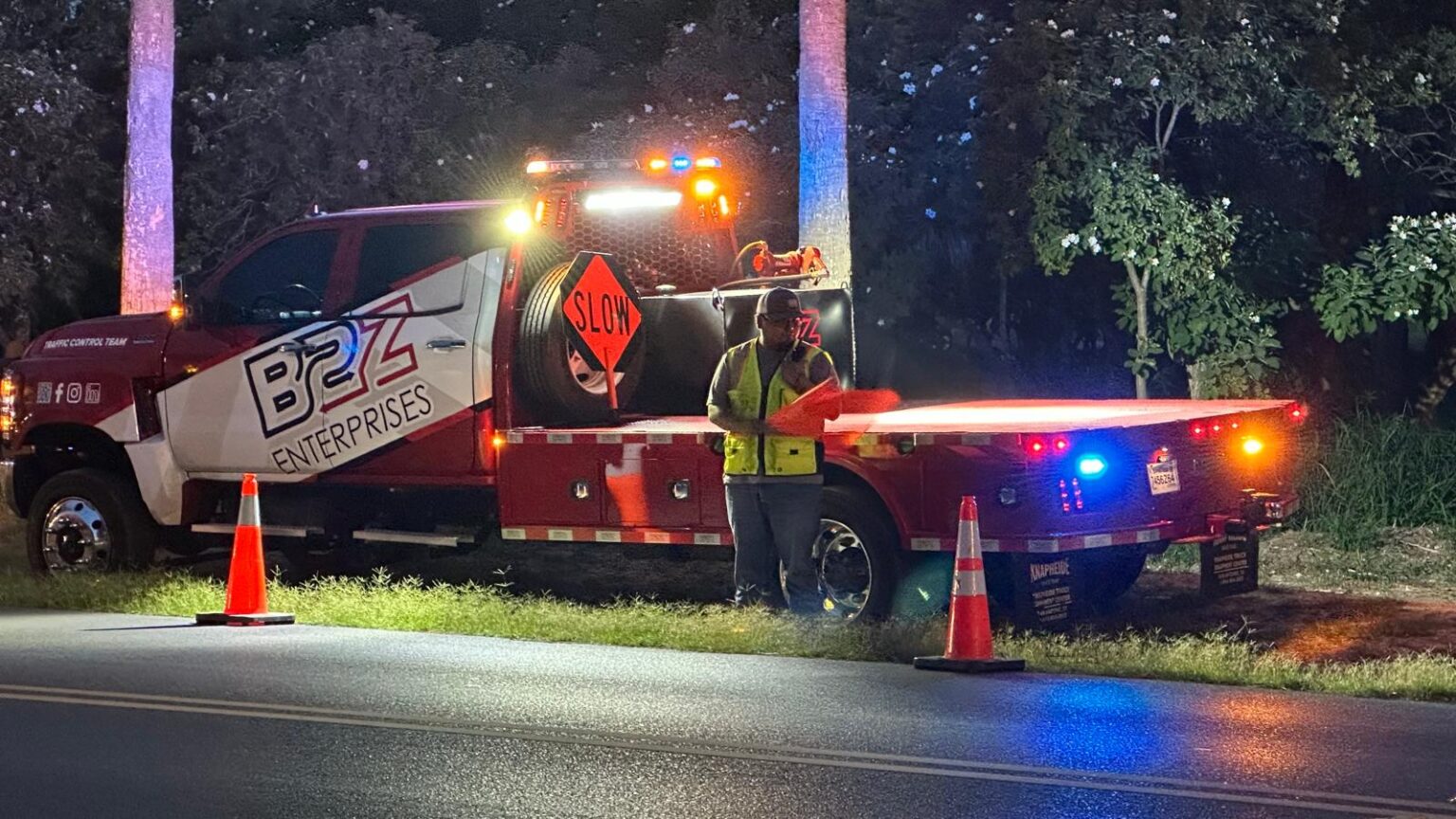
Flaggers in Texas must hold current certification through the American Traffic Safety Services Association (ATSSA) or an equivalent TxDOT-recognized program. At B2Z Enterprises, our flaggers complete initial training and annual refreshers on hand signaling, radio communication protocol, and emergency response. They know how to manage two-way traffic through a single lane, how to time their rotations to avoid long queues, and how to stop traffic safely when a truck needs to back into a utility cut.
Untrained spotters — sometimes used by contractors trying to cut costs — simply do not have this skill set. They stand in the road holding a sign without understanding sight distance, without radio discipline, and without the authority to stop traffic when conditions demand it. The difference between a trained flagger and an untrained spotter is the difference between a controlled work zone and a collision waiting to happen.
Real-world scenarios where flagging is essential include:
- Utility cuts in the middle of a two-lane road where only one lane can remain open
- Water line repairs that require excavating across a driveway or intersection
- Gas line installations that extend into the travel lane from the shoulder
- Highway shoulder work where vehicles need to merge at reduced speed
Want results like this? B2Z Enterprises can help.
How Do Professional Traffic Control Services Reduce Liability for Fort Worth Contractors and Municipalities?
Liability in construction zones is substantial. A single crash involving a worker or a motorist can result in fines, lawsuits, and reputational damage that far exceed the cost of professional traffic control.
Professional services ensure compliance with multiple regulatory frameworks: OSHA’s 1926 Subpart G (Signs, Signals, and Barricades), the TxMUTCD, local Fort Worth ordinances, and specific contract requirements from TxDOT or the city. When a plan is properly designed and documented, it provides a clear defense against claims of negligence. Our TTCPs include inspection logs, daily reports, and photographic documentation that prove every device was placed correctly and maintained throughout the project.
Insurance and bonding are also critical. B2Z Enterprises carries liability insurance and surety bonds that meet or exceed the requirements for public works projects in Fort Worth. Professional traffic control companies are audited by TxDOT for compliance, and our prequalification status means that general contractors and municipalities can hire us with confidence.
The cost-benefit analysis is straightforward. A serious work zone injury can cost hundreds of thousands of dollars in medical expenses, legal fees, and settlement payments. A fatality can cost millions. Professional traffic control services for a typical utility installation project in Fort Worth range from a few thousand to tens of thousands of dollars — a fraction of the potential liability from a single incident.
What Specific Traffic Control Solutions Does B2Z Enterprises Offer for Fort Worth Projects?
With 21 years of experience in Texas, B2Z Enterprises provides a full spectrum of traffic control services tailored to the unique demands of Fort Worth construction. Our solutions include:
- Turnkey MOT plan development and implementation: From initial site assessment to final demobilization, we handle every aspect of traffic control design and execution. We submit plans directly to TxDOT or city reviewers and make revisions as needed.
- Flagging services for short-term and long-term work zones: We deploy ATSSA-certified flaggers for projects ranging from half-day utility repairs to multi-month highway maintenance operations.
- Lane closure coordination for highway maintenance and utility installation: We manage the permitting, scheduling, and on-site setup of lane closures on state and local roads, including the necessary advance notification to first responders.
- Emergency response traffic control: When a water main breaks or a crash blocks a major intersection, we provide rapid-response traffic control within hours — including after-hours and weekend service.
- Custom solutions for special events and large construction sites: Parades, festivals, and large development projects require unique traffic management strategies. We design plans that balance access, safety, and public convenience.
Our local expertise makes the difference. We know the permitting process for the Fort Worth Transportation and Public Works Department. We know which TxDOT inspectors cover which district offices. We know that the intersection of Camp Bowie Boulevard and University Drive presents unique sight-distance challenges during peak hours. That kind of knowledge cannot be replicated by a company that does not work in Fort Worth regularly.
We are based at 900 S. Stewart Road. Ste 12, Mission, TX, but our crews regularly serve projects across the state, including Fort Worth. General contractors and utility companies call us at 956-585-3773 when they need a traffic control partner who understands the local landscape.
How to Choose the Right Traffic Control Partner for Fort Worth Construction Projects?
Selecting a traffic control company is a procurement decision that affects safety, schedule, and liability. Here is what we recommend evaluating:
- Verify certifications and prequalification. Does the company hold ATSSA certifications? Are they TxDOT prequalified for traffic control? Ask for their TxDOT prequalification number and verify it through the state system.
- Ask about experience with your project type. Utility installation traffic control has different requirements than highway maintenance. Look for a company that has done similar work in Fort Worth. For more on this, see our guide on why utility installation traffic control matters more than ever.
- Evaluate response time and availability. Construction delays happen at all hours. A good traffic control partner offers 24/7 emergency service and can mobilize quickly when a project runs over schedule or an incident occurs.
- Review references from local contractors and engineers. Ask for references from general contractors and engineering firms that have worked on Fort Worth projects. Call those references and ask about responsiveness, plan quality, and on-site execution.
- Ensure comprehensive service. The right partner handles everything from planning through demobilization — including documentation, inspection logs, and final removal. Partial-service providers can leave gaps in safety and compliance.
What Does the Future of Work Zone Safety Look Like in Fort Worth?
The traffic control industry is evolving rapidly, and Fort Worth projects will benefit from several emerging trends:
Smart cones and connected vehicle alerts. Technology is making work zones smarter. Cones with embedded sensors can communicate with vehicle navigation systems to provide real-time lane closure information. This reduces driver surprise and improves compliance with temporary traffic patterns.
Automated flagging devices and remote traffic management. Automated flagging devices (AFADs) can manage single-lone closures without putting a person in the roadway. Remote monitoring cameras allow project managers to observe traffic flow from a central location and adjust signal timing or signage as needed.
Stricter enforcement through automated systems. Speed cameras and automated citation systems are being deployed more frequently in Texas work zones. While enforcement is not a traffic control function, it complements our work by deterring speeding through active construction areas.
Emphasis on positive protection. The industry is moving away from reliance on cones and barrels on high-speed roads. Positive protection — concrete barriers, crash cushions, and truck-mounted attenuators — is becoming standard on projects where speeds exceed 45 mph. TxDOT’s own standards increasingly require barrier separation between traffic and workers.
Despite all of this technology, human expertise remains irreplaceable. A TTCP is only as good as the judgment of the people who design it and the flaggers who execute it. For a deeper dive into how local regulations shape these plans, read our comprehensive guide on utility installation traffic control compliance.
At B2Z Enterprises, we combine 21 years of field experience with a commitment to staying current on every regulatory and technological development. Whether your project is a simple utility cut or a multi-phase highway reconstruction, our team delivers the expertise, equipment, and dedication that Fort Worth construction projects demand.
Have a question not covered below? We’re happy to help.
Contact Us or call 956-585-3773
Frequently Asked Questions About Construction Zone Safety in Fort Worth
Is a traffic control plan required for every construction project in Fort Worth?
Yes, if the project affects public roadway access, a TTCP is required by city ordinance and TxDOT standards. Even minor utility cuts in the street typically require an approved plan. The plan must be submitted to the Fort Worth Transportation and Public Works Department or TxDOT’s Fort Worth District Office for review before work begins.
What is the difference between an MOT plan and a TTCP?
An MOT (Maintenance of Traffic) plan is the broader strategy for how traffic will be managed throughout a project. A TTCP (Temporary Traffic Control Plan) is the specific, detailed document that shows sign placement, taper lengths, barrier locations, flagging stations, and other on-site elements. The TTCP is typically the document that gets submitted for approval and used in the field.
How far in advance do I need to book flagging services for a Fort Worth project?
For planned work, we recommend booking at least two weeks in advance to allow time for plan review, permitting, and crew scheduling. For emergency repairs, B2Z Enterprises offers 24/7 rapid response and can typically deploy flaggers within two to four hours for Fort Worth locations.
Do I need a flagger if I am only closing one lane?
In many cases, yes. A single-lane closure on a two-lane road requires traffic control to alternate directions safely. Flaggers are the standard method for this on low-to-moderate-volume roads. On higher-volume roads, a temporary traffic signal may be used, but flaggers are still often needed at entry and exit points to manage merging traffic.
Are there specific training requirements for flaggers in Texas?
Yes. Flaggers in Texas must be trained and certified through ATSSA or an equivalent TxDOT-recognized program. The certification must be current, and refresher training is required periodically. B2Z Enterprises ensures all flagging personnel meet these requirements and carry valid credentials on every job site.
How much does professional traffic control cost for a Fort Worth construction project?
Costs vary widely based on project scope, duration, and complexity. A simple utility cut with a single flagger may cost a few hundred dollars per day. A multi-week highway lane closure with VMS boards, barrier systems, and multiple flaggers can run $5,000 to $15,000 per week. The cost is negligible compared to the liability of an unmanaged work zone.
Ready to get started with B2Z Enterprises?
Visit us at 900 S. Stewart Road. Ste 12, Mission, TX, 78572