
Utility Installation Traffic Control in La Joya: Navigating Local Regulations and Ensuring Worker Safety During Roadwork — Comprehensive Guide
If you’re planning utility installation roadwork in La Joya, you need a traffic control plan that satisfies both city codes and TxDOT standards while keeping workers and the public safe. The key is understanding La Joya’s specific permitting requirements, following the Texas Manual on Uniform Traffic Control Devices (TMUTCD) with local amendments, and deploying certified flaggers and protective devices. B2Z Enterprises handles all of that for you, so your project stays on schedule and avoids fines.
What Are the Key Local Regulations for Utility Installation Traffic Control in La Joya?
Utility work in La Joya falls under overlapping jurisdictions. The city’s Public Works Department enforces its own ordinances for roads it maintains, while the Texas Department of Transportation (TxDOT) governs state highways like Expressway 83, FM 1016, and FM 1426 that run through town. Before you put a cone in the ground, you need to know which set of rules applies at your specific site.
What permits are required from La Joya Public Works?
Any temporary work in La Joya city limits that affects a public right-of-way requires a Traffic Control Permit from the Public Works office at 500 E. Expressway 83. You’ll submit a Temporary Traffic Control Plan (TTCP) showing lane closures, warning signs, and detour routes. The standard review takes 5–7 business days, but if your work touches a school zone (like near La Joya Elementary on Los Ebanos Road) or a major intersection, expect 10–12 days. Fees range from $75 for a basic residential closure to $350 for arterial road restrictions. B2Z Enterprises prepares these plans daily and knows exactly which details the reviewers look for — like proper taper lengths for La Joya’s narrow streets.
B2Z Enterprises — the local area
Modern solutions for today’s challenges. Let’s build something great.
or call 956-585-3773
How does TxDOT add a layer of oversight?
When your utility installation is on or immediately adjacent to a state-maintained roadway, TxDOT’s Pharr District office must approve your Maintenance of Traffic (MOT) Plan. They require compliance with the Federal Highway Administration’s Manual on Uniform Traffic Control Devices (MUTCD) and the Texas-specific supplement (TMUTCD). A common local amendment: La Joya requires channelizing devices every 25 feet on residential streets rather than the standard 50 — a nuance that catches out-of-town contractors all the time.
Why do emergency vehicle access and school bus routes matter so much here?
La Joya’s road network includes several narrow, older streets (like those in the La Casita neighborhood) where a single lane closure can block emergency vehicles. The city fire department requires documented pre-coordination before any closure. Similarly, school bus routes are heavily concentrated along FM 2221 and Los Ebanos Road — blocking those during drop-off or pickup can land you a code violation. B2Z Enterprises always runs a route check with the La Joya ISD transportation office before finalizing any plan.
How Do You Create a Compliant Temporary Traffic Control Plan (TTCP) for La Joya Utility Projects?
What does the site assessment involve?
We start by evaluating traffic volume — not just peak-hour average, but specific patterns unique to La Joya. For example, our work near the La Joya City Hall on FM 1426 sees heavy foot traffic during municipal court days. We measure sight distances at each approach, identify driveways that can’t be blocked (like the emergency entrance at the La Joya Medical Plaza), and note any utility vaults or fire hydrants in the work zone.
What must every TTCP include?
Your plan sheets, submitted in PDF format, must show:
- Advanced warning signs with specific placement distances (e.g., “Road Work Ahead” 500 feet before the zone on a 35 mph street).
- Channelizing devices — cones, drums, or temporary barrier rails — with spacing per MUTCD Section 6F.58.
- Flagging stations located where motorists have at least 300 feet of visibility.
- Lane closure schedules that avoid the 7:00–8:30 AM and 4:00–5:30 PM windows on arterials.
- Contingency plans for weather events (common in the Rio Grande Valley) and emergency vehicle access.
Want results like this? B2Z Enterprises can help.
What Worker Safety Measures Are Mandatory During Utility Installation in La Joya?
Interested in Flagging Services?
B2Z Enterprises brings modern expertise to every engagement.
What specific OSHA standards apply?
Under 29 CFR 1926 Subpart G, any worker exposed to vehicular traffic must wear high‑visibility apparel. In La Joya, speed limits on Expressway 83 (up to 65 mph) push the requirement to ANSI/ISEA 107 Class 3 — the highest level of background material and retroreflective tape. On residential streets, Class 2 suffices. Our crews always wear Level 3 on state‑maintained routes, even if the posted speed is lower, because we’ve had near‑misses with exceeding‑speed drivers near the FM 1016 overpass.
How far from the work area should flaggers stand?
Flagger positioning follows MUTCD Table 6F‑1. For a 40 mph road, the flagger station should be at least 200 feet before the work zone. But in La Joya, we often adjust for curves: at the curve on FM 1426 south of the city limit, we place the flagger 350 feet ahead to maintain the required 500‑foot stopping sight distance.
What protective barriers are needed?
Temporary impact attenuators (TMA) are mandatory on highways above 45 mph when a lane closure leaves workers within 15 feet of live traffic. On Expressway 83, we deploy truck‑mounted crash cushions and channelize with water‑filled barrier segments. For lower‑speed work, Type I or II barricades with continuous lighting are standard.
Where are the nearest hospitals for emergency planning?
Our emergency response plan always lists the nearest emergency rooms — Rio Grande Regional Hospital in McAllen (about 15 minutes from central La Joya) and Mission Regional Medical Center (about 12 minutes). We pre‑coordinate with the La Joya EMS station at 800 N. Bridge Street and keep a first‑aid kit on every truck.
How Does B2Z Enterprises Handle Lane Closures and Traffic Flow Disruptions in La Joya?
What pre‑closure steps do we take?
We notify the La Joya Police Department 48 hours before any lane closure on a major arterial. They provide a traffic control officer for complex intersections (like the Expressway 83 / FM 1016 junction) at an additional $45/hour. We also contact the La Joya Traffic Management Center at City Hall to request adaptive signal timing adjustments — for example, extending green phases on parallel routes to absorb diverted traffic.
How do we time closures to avoid peak school traffic?
La Joya has three elementary schools clustered within a mile of each other. We avoid any lane closure between 7:15–8:45 AM and 2:30–4:00 PM within two blocks of a school. When possible, we schedule utility work in residential areas (like the Las Quintas neighborhood) between 9 AM and 3 PM, after speaking with the Homeowners Association about temporary parking restrictions.
What detour routes work best in La Joya?
For work on Expressway 83, we usually route traffic onto FM 1426 to Mile 6 Road, then back. On FM 1016, detours via Los Ebanos Road and Bridge Street keep traffic moving. Our plans include digital message boards at every decision point, updated in real‑time if congestion builds. We also post updates on the City of La Joya’s social media and on local radio alerts — something we learned after a 2023 project on Mile 7 Road caused an hour‑long backup without notice.
What Are the Flagging Services Best Practices for La Joya Utility Roadwork?
What certifications do flaggers need in Texas?
Every flagger must complete an approved Texas flagger training course, such as the one offered by the Texas Engineering Extension Service (TEEX). La Joya additionally requires that flaggers carry a pocket card showing the date of training and the course provider. Our flaggers renew their certification every two years and undergo an annual refresher specific to Rio Grande Valley weather hazards — like high winds that affect flag stability.
How do we handle communication with school buses and farm vehicles?
La Joya sits at the heart of an agricultural region. We train our flaggers to give extra spacing and hand signals for slow‑moving farm tractors and hay trucks. School buses require special attention: our flaggers know the exact bus stop locations along FM 1426 and will never block a bus from entering or exiting a stop. We use two‑way radios on private channels to coordinate with bus drivers.
What about nighttime operations?
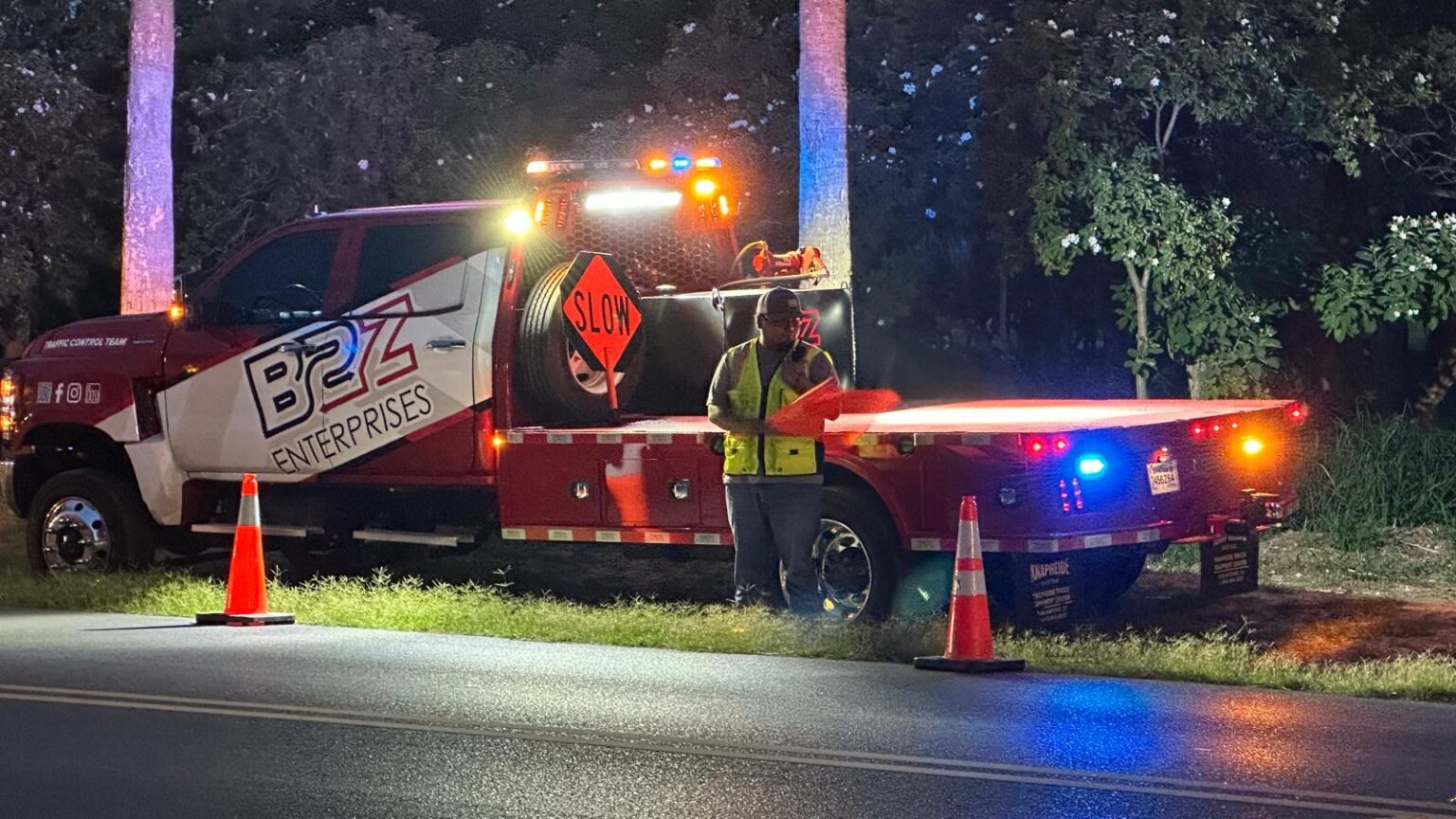
Night work on highways like Expressway 83 is common to reduce traffic impact. Our flaggers wear Class 3 reflective gear with supplemental LED lights. We place illuminated channelizing devices every 15 feet and use portable light towers at the flagger station to ensure they’re visible from 1,500 feet. We also position an advanced warning sign with yellow flashing lights at the start of the taper.
How Do You Ensure Work Zone Safety During Highway Maintenance Traffic Control in La Joya?
What special considerations apply to Expressway 83 and I‑2 borders?
Expressway 83 runs as a four‑lane divided highway through La Joya, with speeds up to 65 mph. The MUTCD requires a minimum taper length of 650 feet for a single‑lane closure at that speed. We use temporary traffic signals and portable changeable message signs to inform drivers 2,000 feet before the closure. On the short stretch of Interstate 2 that borders La Joya’s southern edge, TxDOT mandates a work zone layout with a full buffer space of 200 feet between the work area and the travel lane — we’ve seen contractors get cited for reducing that to 100 feet.
How do we coordinate with emergency services?
We provide La Joya Fire and EMS with gate‑lock keys to any barrier enclosures and a map of all emergency crossing points. During a closure on FM 1016 last October, we kept a lane open for a fire engine responding to a call in Colonia La Homa — because we had pre‑positioned a flagger at that crossing.
How does the Rio Grande Valley climate affect safety?
Sweat, dust, and glare are our biggest challenges. Workers are trained to hydrate every 20 minutes during the summer, when heat indices exceed 105°F. We install shade structures at flagger stations and require sun‑blocked hard hats. After heavy rains, standing water can make pavement markings invisible — we immediately deploy additional warning signs and reduce speed limits on the advance warning boards.
How Can B2Z Enterprises Help You Comply with La Joya’s Utility Installation Traffic Control Requirements?
As a TxDOT‑certified traffic control company operating throughout the Rio Grande Valley, B2Z Enterprises brings 0 years of hands‑on experience specifically in La Joya’s unique corridor. We don’t just write plans — we have the relationships with city planners, the fire marshal’s office, and the school district to fast‑track approvals. Our flagging services rely on crews who live in La Joya and know every curve and crosswalk.
When a contractor needed emergency lane closure services on Expressway 83 after a water main break at 1 AM, we had a work zone safety team on‑site within 35 minutes. We pre‑built MOT plans and TTCP traffic control plans that met TxDOT and La Joya codes, and we handled the coordination with public works before dawn.
We also provide post‑project documentation — including photos, device inventories, and incident logs — that help contractors prove compliance during audits. And yes, we can send you a free initial site assessment; just call us at 956‑585‑3773 or visit our Mission office at 900 S. Stewart Road. Ste 12, Mission, TX.
To see how similar standards apply in the Austin market, check out our analysis of why traffic control companies in Austin matter more than ever and our expert rating of top traffic control services in Austin.
Anything else? B2Z Enterprises is one message away.
Frequently Asked Questions about Utility Installation Traffic Control in La Joya
How long does it take to get a traffic control permit from La Joya Public Works?
Standard review is 5–7 business days. If your project involves a major arterial or a school zone, budget 10–12 days. Expedited review (2 days) is available for emergency utility repairs with a 50% surcharge on the permit fee.
Do I need a separate MOT plan for work on FM 1016 versus a city street?
Yes. State roads (FM 1016, FM 1426, Expressway 83) require a TxDOT‑approved Maintenance of Traffic plan submitted to the Pharr District Office. City streets require a TTCP approved by La Joya Public Works. B2Z Enterprises prepares both and ensures consistency between the two if the project crosses jurisdictions.
What type of high‑visibility apparel is required in La Joya?
On roads with speed limits of 45 mph or higher, ANSI/ISEA 107 Class 3 is mandatory. On residential streets (25–35 mph), Class 2 is acceptable. However, we recommend Class 3 for all state‑maintained routes to provide a safety margin for drivers who exceed the limit.
How close can I place a lane closure to a school?
You must maintain a buffer of at least 200 feet from the school building or any designated school bus stop. During school arrival and dismissal times (7:00–8:30 AM and 2:30–4:00 PM), no lane closures are allowed within two blocks of any La Joya ISD campus.
What should I do if an emergency vehicle approaches my work zone?
Immediately stop all work, cease vehicle movements, and have flaggers clear a path. Every B2Z Enterprises crew maintains a pre‑planned emergency vehicle access route and trains flaggers on hand‑signal commands to halt traffic. We also give local EMS direct radio access to our site superintendent.
Can I use my own workers as flaggers if they have training?
Yes, as long as they hold a current Texas flagger training certificate from an approved provider. However, many contractors in La Joya prefer to hire experienced flagging companies like B2Z Enterprises because our crews are already certified, know local traffic patterns, and carry the required high‑visibility gear and two‑way radios.