Top Places in Roma for Utility Installation Traffic Control Services — Expert Guide
If you’re planning utility work anywhere in Roma, the traffic control requirements are different from what you’ll find in the larger Rio Grande Valley. Narrow streets, fast highway traffic on US-83, and a historic downtown that packs in pedestrians and parked cars mean that a one-size-fits-all Temporary Traffic Control Plan (TTCP) will fail. The key is matching the traffic control strategy to the specific neighborhood. Drawing from years of local experience—our team has managed lane closures, flagging, and full MOT plans on nearly every major road in Roma—this guide walks you through each distinct zone and explains exactly what traffic control services are needed.
Why Do Utility Installations on US-83 Highway in Roma Demand Specialized Traffic Control?
US-83 is the primary north-south artery through Roma, carrying high volumes of traffic at speeds that can exceed 65 mph. A single lane closure for a water line tie-in or fiber optic pull can create a dangerous situation if not handled properly. The Texas Manual on Uniform Traffic Control Devices (TMUTCD) is the governing standard, and TxDOT requires a pre-approved TTCP for any work in the highway right-of-way. Our crews are trained to set up advanced warning signs, tapered lane closures, and flagging stations that match the specific sight distances on each stretch of US-83. For example, the curve near the Roma–Los Saenz area limits visibility—our TTCP designs place advanced warning signs 1,000 feet before the work zone, well beyond the minimum 500 feet required.
B2Z Enterprises — McAllen, TX
Edinburg, TX
Pharr, TX
San Juan, TX
Alamo, TX
Donna, TX
Weslaco, TX
Mercedes, TX
Harlingen, TX
San Benito, TX
Brownsville, TX
Rio Grande City, TX
Roma, TX
La Joya, TX
Palmview, TX
Modern solutions for today’s challenges. Let’s build something great.
or call 956-585-3773
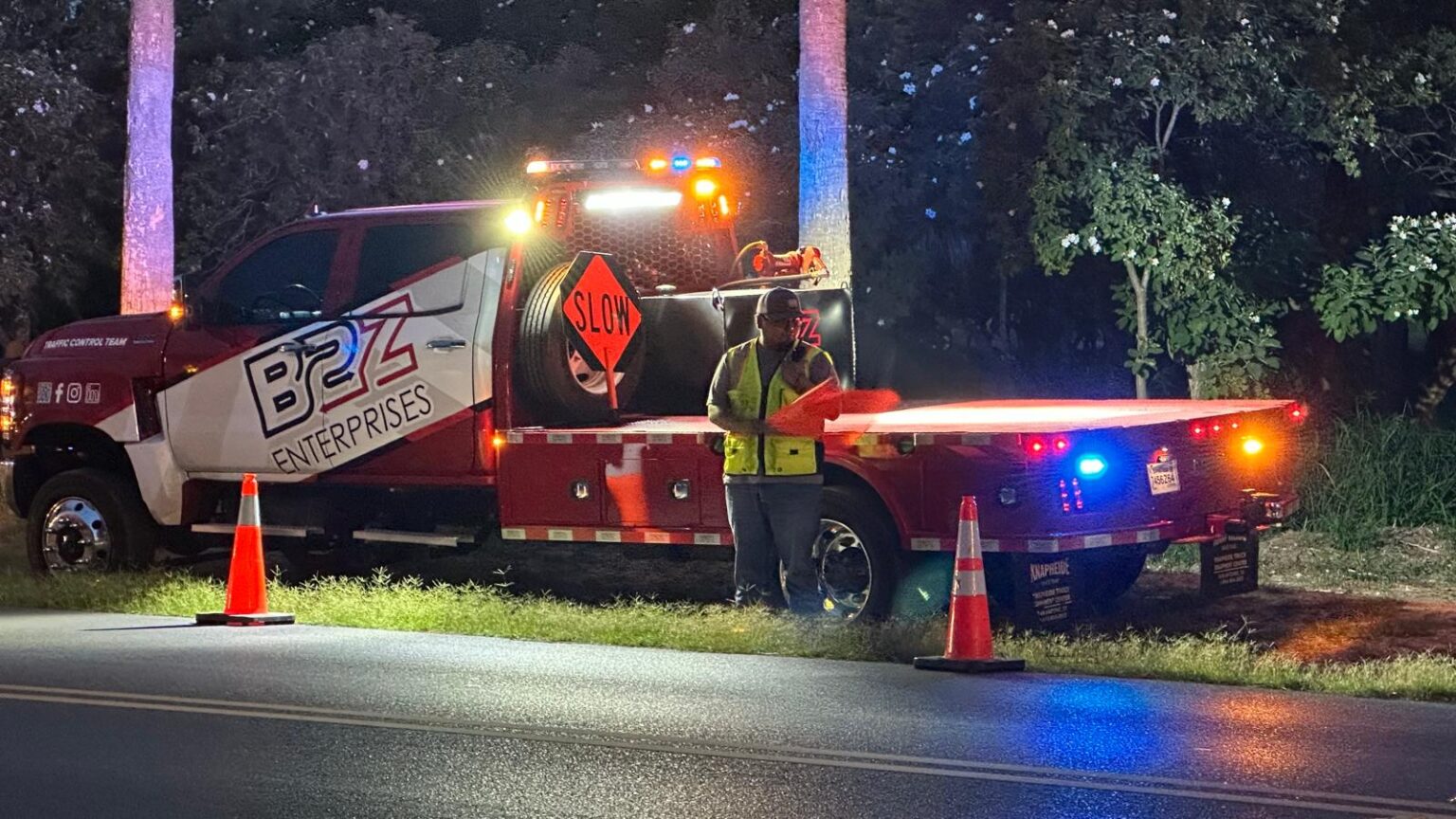
High traffic volume and speed necessitate comprehensive Temporary Traffic Control Plans (TTCP). The speed differential between stopped construction vehicles and passing traffic is the biggest risk. We use temporary concrete barriers and truck-mounted attenuators where the work zone is open for more than a single shift. Multiple lane closure scenarios require coordinated flagging services and advanced warning devices. On a two-lane section, flaggers need to communicate wirelessly to ensure alternating one-way flow without backups. B2Z Enterprises provides flaggers who are TxDOT-certified and equipped with radio headsets. Work zone safety solutions must meet TxDOT standards for highway maintenance traffic control. We reference TxDOT’s official Work Zone Safety guidelines and the FHWA Manual on Uniform Traffic Control Devices on every project. B2Z Enterprises provides customized MOT plans to minimize disruption while protecting crews. We coordinate with the Roma Maintenance Office to schedule lane closures during off-peak hours—usually between 9 a.m. and 3 p.m.—and we keep emergency access open for the Roma Fire Department and EMS.
How Does B2Z Enterprises Manage Traffic Control on Roma’s Residential Streets?
Roma’s residential neighborhoods—like the areas around Roma High School and the colonias east of US-83—present a completely different challenge. Streets are narrow, often with cars parked on both sides, and utility installations frequently require digging in front of driveways or sidewalks. Narrow roads and limited visibility require precise lane closure strategies and flagging services. A typical residential street in the Roma Creek subdivision is only 24 feet wide. We close one lane and use a single flagger at each end to alternate traffic. The flagger’s position has to be far enough away from the excavation to give drivers time to stop, but also visible around curves or mailboxes. Utility work near driveways and sidewalks calls for pedestrian-friendly work zone safety solutions. Under the Americans with Disabilities Act (ADA Title III) and local ordinances, we must leave a clear path of travel for pedestrians. Our MOT plans include temporary walkways with detectable warning surfaces and steel plates over trenches so residents can cross safely. Temporary Traffic Control Plans (TTCP) are tailored for low-speed, high-access environments. We use smaller Type I barricades and orange mesh fencing instead of heavy concrete barriers, because residents need to drive in and out multiple times a day. MOT plans ensure emergency vehicle access remains open at all times. We leave an 11-foot-wide emergency lane on every residential street, and we notify the volunteer fire department 48 hours before any lane closure.
Residents appreciate the quick response. For example, a homeowner in the La Lomita neighborhood called us at 8 a.m. about a water line repair that blocked their driveway. B2Z Enterprises had a TTCP and a flagger on-site by 9:15, and the driveway was reopened by noon.
What Makes the Roma Downtown District a Challenge for Utility Installation Work?
Interested in Work Zone Safety Solutions?
B2Z Enterprises brings modern expertise to every engagement.
Roma’s historic downtown, centered around Main Street and Estrella Street, is a National Register Historic District. The streets are narrow, sidewalks are crowded with pedestrians visiting shops and the county courthouse, and on-street parking is at a premium. Dense pedestrian traffic and on-street parking complicate lane closures and flagging operations. We can’t simply block a lane without first coordinating with the Roma Main Street Program and the City’s public works department. Historic structures may require special clearance and reduced vibration during utility installations. Building foundations that are over a century old can crack if heavy equipment impacts the ground nearby. Our MOT plans incorporate a “no-vibration zone” within 10 feet of historic facades, and we use hand digging or vacuum excavation in those sections. Intersection control demands phased TTCP designs to avoid gridlock. The intersection of Main and Estrella can back up for blocks if we close more than one approach. We phase the work: first close the northbound lane, complete the excavation, restore pavement, then move to the southbound lane. Flaggers are positioned at each corner to direct pedestrians away from work areas and to hold traffic for turning vehicles. B2Z Enterprises deploys advanced work zone safety solutions for tight urban corridors. We use solar-powered LED arrow boards and temporary rumble strips to alert drivers in the narrow streets.
We also coordinate with the city for permits. The city’s traffic engineer requires a TTCP submission 14 days in advance for any downtown lane closure. Our team has the templates and local knowledge to get those approved quickly.
Which Industrial Zones Near Roma Require Robust Highway Maintenance Traffic Control?
South of downtown, along FM 650 and Roma-Cistern Road, you’ll find light industrial parks and warehouses that support agriculture and oilfield services. These roads are heavily used by semi-trucks and farm equipment. Truck-heavy routes (e.g., FM 650 or Roma-Cistern Road) need durable traffic control devices. A plastic cone won’t survive a turning big rig. We use 42-inch tall Type III barricades with reflective sheeting and ballast weights. Utility installations in industrial parks require MOT plans that account for large vehicle turning radii. A semi needs at least 40 feet of clearance to turn. If our work zone is near an intersection, we set back the taper far enough to allow trucks to swing wide without entering the work area. Flagging services must be coordinated with warehouse loading schedules to prevent backlogs. We talk to each warehouse manager to find out peak shipping times. If a company loads exports from 2 p.m. to 6 p.m., we schedule our lane closures for the morning shift. B2Z Enterprises offers 24/7 work zone safety solutions for round-the-clock industrial projects. Some manufacturing plants run three shifts and need utility work done overnight. Our crews are available for night flagging, with high-visibility apparel and vehicle lighting that meets TxDOT nighttime work requirements.
We recently helped a natural gas pipeline contractor install a new tap on Roma-Cistern Road. They needed a lane closure for 10 hours over three days. B2Z Enterprises developed a TTCP that kept both travel lanes open during the morning and evening truck rush, and closed only the shoulder during midday. Flaggers held traffic for five minutes at a time to let the excavator cross the road. The project finished on schedule without a single accident.
How to Plan Traffic Control for Utility Installations Near Roma Schools and Parks?
Roma has several schools—Roma High School, Roma Middle School, and several elementary campuses—plus parks like Roma City Park and the nearby Falcon State Park access. Utility work near these areas requires extra sensitivity. School zone speed limits and timing restrictions dictate when lane closures and flagging can occur. In Texas, school speed zones are active when children are present or when the flashing lights are on. We cannot close a lane in a school zone during drop-off (7:30–8:30 a.m.) or pick-up (3:00–4:00 p.m.) without prior approval from the school district and the city. Our TTCPs always include a “no-work” time window for school hours. TTCP designs include crosswalk management and parent drop-off/pick-up lane protection. We use temporary crosswalk signs and flaggers to escort parents walking to the school entrance. The drop-off lane must remain open; we stage our equipment on the opposite side of the street or in a parking lot. Utility work near parks requires temporary pedestrian detours and enhanced work zone safety solutions. At Roma City Park, families with strollers and bikes use the sidewalks. We set up a detour on the grass using orange mesh and plywood walkways, with signs that say “Pedestrian Detour” in both English and Spanish. B2Z Enterprises coordinates with local authorities to align MOT plans with school schedules. We contact the Roma ISD maintenance office and the city parks department a week in advance to get their input and to ensure we have the proper permits. Our careful planning prevents delays and keeps kids safe.
Why Choose B2Z Enterprises for All Your Traffic Control Needs in Roma?
We’ve been the go-to traffic control company for utility installation and highway maintenance in Roma for years. Local expertise in Roma’s road networks and utility infrastructure means we know every curve, intersection, and permit requirement. Full suite of services: MOT plans, TTCP, flagging, lane closures, work zone safety solutions. We handle the entire traffic control scope—from design to on-site execution—so you don’t have to hire multiple subcontractors. Proven track record with utility installation traffic control and highway maintenance traffic control. Our Google reviews (4.9 out of 5 from over 50 reviews) reflect our dedication. We hold TxDOT pre-qualification and our crew members are certified in flagging and traffic control management. Customized, compliant, and cost-effective work zone safety solutions for every project type. Whether you need a one-day lane closure on US-83 or a month-long phasing plan in the historic district, we deliver. You can reach us at 956-585-3773 or visit our office at 900 S. Stewart Road. Ste 12, Mission, TX. We’re ready to help with your next utility installation project in Roma.
| Aspect | B2Z Enterprises (Professional Service) | DIY / In-House |
|---|---|---|
| TTCP Design | TxDOT-approved plans with site-specific adjustments | Generic templates that may need revision by DOT |
| Flagging Personnel | TxDOT-certified flaggers with radios | Temporary laborers without certification |
| Equipment | Advanced warning signs, arrow boards, attenuators | Basic cones and signs from rental yard |
| Permit Compliance | Guaranteed city and TxDOT approval | Risk of fines or stop-work orders |
| Cost | Predictable, all-inclusive | Hidden costs for rework, delays, and fines |
| Liability | Insured and bonded | Contractor bears full risk |
For example, a contractor upgrading gas lines in the Roma Historic District came to B2Z Enterprises because they were facing a 2-week delay after the city rejected their self-made TTCP. Their original plan didn’t account for the pedestrian detour around the courthouse and lacked proper flagger positions at the Main/Estrella intersection. Our team redesigned the plan, submitted it to the city, and had it approved in 3 days. We then provided certified flaggers and all traffic control devices. The utility installation finished 4 days ahead of schedule, and the contractor saved $3,500 in potential daily overtime costs.
Want results like this? B2Z Enterprises can help.
Frequently Asked Questions
Anything else? B2Z Enterprises is one message away.
Do I need a traffic control plan for a short utility repair on a residential street in Roma?
Yes. Even a single-day repair that blocks part of the street requires a MOT plan under TxDOT standards. For residential streets, the plan can be simpler, but it must address flagging, signage, and pedestrian access. B2Z Enterprises can create a basic TTCP and set up the work zone quickly.
How far in advance should I book traffic control services for a utility installation in Roma?
We recommend at least two weeks for highways like US-83 and downtown historic zones because city approval takes time. For residential or industrial areas, one week is usually enough. Last-minute requests may still be accommodated, but plan availability could be limited.
Does B2Z Enterprises handle night or weekend work for utility installations?
Absolutely. We offer 24/7 flagging and work zone safety solutions. Night work is common on US-83 to avoid daytime traffic, and we have the lighting and high-visibility equipment required by TxDOT for overnight operations.
What permits are required for lane closures on US-83 in Roma?
You need a TxDOT lane closure permit and a TTCP approved by the Roma Resident Engineer’s office. For work within the city limits, you may also need a city obstruction permit. B2Z Enterprises handles both permit applications as part of our full-service MOT plan.
Can you provide flaggers who speak Spanish for work in Roma neighborhoods?
Yes. Many of our flaggers are bilingual in English and Spanish, which is critical for communicating with residents and workers on utility projects. We ensure all signage includes Spanish where appropriate.
How much does professional traffic control cost for a utility installation in Roma?
Costs vary based on the size and duration of the work zone. A typical one-day residential lane closure with flaggers and signs starts around $1,200. Complex highway projects with multiple closures and night shifts can run $5,000–$10,000 per week. Contact us for a free quote specific to your project.