
B2Z Enterprises
Utility Installation in Roma: Mastering TxDOT Traffic Control to Prevent Delays and Ensure Safety — Comprehensive Guide
If your utility project on FM 650 or near the Roma Historic District has ever been shut down by a TxDOT inspector because your signage was six feet off, you know the frustration. Getting it right means a compliant Temporary Traffic Control Plan (TTCP) that protects your crew, keeps traffic moving through Roma’s narrow downtown corridors, and avoids fines that can reach thousands of dollars per violation.
Why Is TxDOT Traffic Control Compliance Critical for Utility Installation Projects in Roma?
TxDOT regulates every inch of work performed on state rights-of-way in Roma, from the Pharr-Roma International Bridge approaches to the rural stretches of US 83. Non-compliance is not a minor paperwork issue — it can halt your project on the spot, expose you to liability under the Texas Tort Claims Act, and put every worker and driver at risk.
Step 1: Find Your Expert in McAllen, TX
Edinburg, TX
Pharr, TX
San Juan, TX
Alamo, TX
Donna, TX
Weslaco, TX
Mercedes, TX
Harlingen, TX
San Benito, TX
Brownsville, TX
Rio Grande City, TX
Roma, TX
La Joya, TX
Palmview, TX
B2Z Enterprises is your local resource. Here’s how to get started.
Call 956-585-3773
What specific TxDOT regulations apply to utility work in Roma?
Utility installations fall under TxDOT’s specification for Maintenance of Traffic (MOT) during construction, governed by the Texas Manual on Uniform Traffic Control Devices (TMUTCD). Part 6 of the TMUTCD outlines every detail: how far in advance warning signs must be placed (200 to 1,000 feet depending on speed), the maximum taper length for lane closures, and the certification requirements for flaggers. Failing to meet these standards means a TxDOT utility inspector can issue a notice of non-compliance, and you may have to demobilize and reapply for permits.
What are the real penalties for traffic control violations in Roma?
Beyond the immediate stop-work order, fines for non-compliance with TxDOT MOT standards can reach $5,000 per day per violation under Texas law. If an accident occurs — a driver hits a worker, a pedestrian trips over an unmarked trench — your company faces direct liability. OSHA’s construction safety standards also apply, and a serious violation can trigger federal penalties of up to $15,625 per incident.
How does proper traffic control protect workers and the public in Roma?
Roma’s mix of high-speed highway traffic on US 83, school zone crossings near Roma High School, and pedestrian traffic in the historic district creates a complex risk environment. A well-designed MOT plan separates these conflicting flows with proper channelizing devices, advance warning signs, and trained flaggers. The goal is zero contact between traffic and the work zone — and that only happens when every element of the TTCP is correctly executed and inspected.
What Are the Key Components of a Maintenance of Traffic (MOT) Plan for Utility Work?
Every utility excavation, vault installation, or directional bore in Roma requires a site-specific MOT plan that addresses the road geometry, traffic volume, and nearby land uses. Here are the components that matter most.
Work zone layout design: How do you set up tapers, buffer spaces, and sign placement?
The TMUTCD specifies that lane closure tapers on roads with speed limits above 40 mph require a minimum merging taper of 100 feet per 10 mph of posted speed. On a 65-mph section of US 83, that means 650 feet of taper before the closed lane. Buffer spaces — the clear zone between the traffic control devices and the workers — must be at least 50 feet on higher-speed roads. Sign placement follows a similar formula: warning signs at advance distances of 500 to 1,000 feet, set back 10 to 12 feet from the edge of the traveled way.
What traffic control devices are required for utility work zones?
For a typical utility installation in Roma, you need Type I or Type II barricades, cones (minimum 28-inch height for nighttime), reflective delineators, and arrow boards for lane closures. All devices must meet the retroreflectivity standards of TxDOT’s Standard Specification Item 700. Using substandard or faded devices is one of the most common reasons for TxDOT rejection during inspection.
How do flagging operations work on Roma’s two-lane and multi-lane roads?
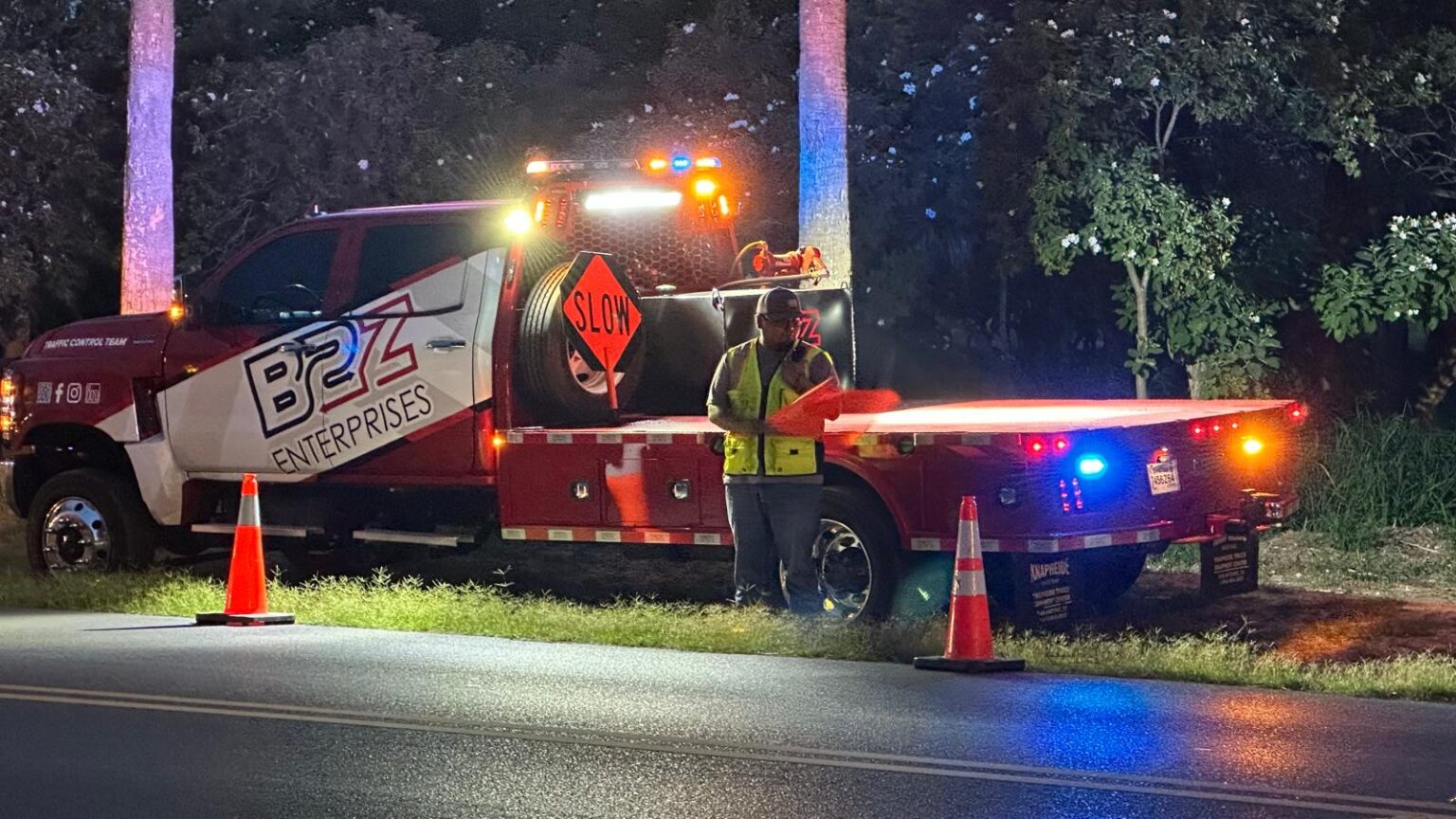
On FM 650, where you may have to close one lane of a two-lane road, flaggers control alternating traffic flow. TxDOT requires flaggers to hold current certification through an ATSSA-accredited program or the Texas Engineering Extension Service (TEEX). Each flagger must use the approved STOP/SLOW paddle, wear high-visibility ANSI 107 Class 3 apparel, and maintain radio contact with the other flagger and the crew supervisor. On multi-lane roads, flaggers are typically supplemented with portable traffic signals to maintain consistency.
What about lane closure strategies — partial, full, and nighttime closures?
Partial closures — blocking one lane while keeping the others open — are common on US 83 during directional boring. Full closures require detour signage approved by TxDOT and are typically reserved for short-duration work like manhole installations. Nighttime closures on Roma’s major corridors reduce traffic impact but add lighting requirements: all signs must be illuminated or have reflectorized faces, and the work area must have at least 20 lux of lighting per TxDOT standards.
How do you accommodate pedestrians and cyclists near work zones in Roma?
Sidewalk closures near the Roma Historic District or the downtown commercial area require pedestrian detours that comply with the Americans with Disabilities Act (ADA Title III). Temporary walkways must be a minimum of 48 inches wide with a slip-resistant surface. Cyclists on US 83’s shoulders need advance warning and, when the shoulder is closed, a signed alternate route.
How Can You Prevent Costly Delays During Utility Installation in Roma?
Step 2: Learn About Flagging Services
B2Z Enterprises can guide you through every detail. Reach out with questions.
Delays on utility projects in Roma rarely come from bad weather — they come from failed inspections, missing permits, and traffic control setups that take too long to install and remove. Here is how to avoid those pitfalls.
What pre-construction coordination is needed with TxDOT and local authorities?
Before any barricade goes up, you need a pre-construction meeting with the TxDOT Roma district office and, if the work is on a city street, the City of Roma’s engineering department. This meeting covers the approved TTCP, the inspection schedule, and emergency contact procedures. Skipping this step is the fastest way to get a stop-work order.
How do you manage permit acquisition and timeline for utility work?
Utility permits in Roma must be submitted through TxDOT’s Online Permitting System at least 14 business days before the planned start date. The permit application requires a site plan, the TTCP, and proof of flagger certifications. Lacking any of these documents can delay approval by weeks.
When should you schedule work to minimize traffic impact in Roma?
Off-peak hours in Roma — typically between 9:00 AM and 3:00 PM on weekdays — see the lightest traffic, especially on FM 650 away from the school zones. For work near the Roma-Cuellar International Bridge, early morning starts before 6:00 AM or weekend closures are often the only way to avoid traffic backing up onto the bridge approach.
What Safety Measures Must Be Included in a Temporary Traffic Control Plan?
A TTCP for utility installation in Roma must go beyond the minimum TMUTCD requirements. Here are the safety measures that keep your crew alive and your project compliant.
Advance warning signs and speed reduction zones
Signs like “ROAD WORK AHEAD” and “LANE CLOSURE” must be placed sequentially at distances defined by the road speed. On Roma’s 65-mph highways, that means a first sign at 1,500 feet, a second at 1,000 feet, and a “MERGE” sign at 500 feet. Speed reduction zones — dropping to 45 mph through the work zone — are enforceable only if posted with proper regulatory signs and a Shadow Vehicle with a flashing arrow board.
Channelizing devices to guide traffic
Cones and barrels create the visual path drivers follow. The spacing between devices on a straight section cannot exceed 40 feet per TMUTCD Section 6F.60. On curves approaching the work zone, spacing must be reduced to 20 feet. Using damaged or missing reflective sheeting on these devices is one of the most common defects cited by TxDOT inspectors in Roma.
Work zone lighting for nighttime operations
If you are doing utility work at night on US 83 near the Port of Entry, every sign must be illuminated or made of retroreflective material meeting ASTM D4956 Type XI standards. Flashing lights on barricades are required at 12-foot intervals. Portable light towers must provide even illumination over the entire work area to eliminate glare for drivers.
Worker visibility and training requirements
Every worker in the work zone must wear ANSI 107 Class 3 high-visibility apparel with reflective stripes — not just the flaggers. Hard hats are mandatory per 29 CFR 1926.100. OSHA’s construction standards require that all workers be trained on the specific hazards of the work zone, including moving equipment, underground utilities, and traffic.
How Do Flagging Services Enhance Safety and Efficiency on Roma Job Sites?
Flagging is the human element of traffic control — and in Roma’s tight corridors and school zones, it can be the difference between a smooth operation and a collision. Professional flaggers bring certification, training, and real-time decision-making that signs and cones cannot replace.
What certification do flaggers need for TxDOT projects in Roma?
TxDOT requires flaggers to hold a current certification from a recognized training provider such as the American Traffic Safety Services Association (ATSSA). The initial training covers hand signaling, flagging patterns for two-lane and multi-lane roads, and emergency response. Recertification is required every four years.
How do flaggers coordinate with heavy equipment on utility sites?
On a typical utility installation, a backhoe or directional drill rig operates within the work zone while flaggers control traffic at both ends of the closure. Communication between the flaggers and the equipment operator is critical — a two-second delay in signaling can put a worker or driver in harm’s way. That is why our flagging teams at B2Z Enterprises use two-way radios with headsets on every project in Roma.
Want results like this? B2Z Enterprises can help.
When Should You Hire a Professional Traffic Control Company for Utility Installation?
Many utility contractors in Roma try to handle traffic control with their own crews and rented equipment. It seems simpler — until the TxDOT inspector arrives and finds six compliance issues. Here is when it is time to bring in a professional firm like B2Z Enterprises.
Complex or high-traffic intersections in Roma
If your utility work is at the intersection of US 83 and FM 650 — one of the busiest crossings in Roma — you need a traffic control company that understands how to manage multiple turning movements, truck traffic, and pedestrian crossings simultaneously. One wrong sign placement here can cause a rear-end collision.
Multi-phase utility work requiring frequent lane changes
Projects that move down a road over several weeks — like sewer line rehabilitation or fiber optic installation — need daily adjustments to the traffic control setup. Professional traffic control companies carry the inventory of devices and the trained crews to reconfigure the work zone quickly each morning.
Projects near schools, hospitals, or commercial zones in Roma
Work zones near Roma High School, the Starr County Memorial Hospital, or the retail corridor on Main Street require special attention to pedestrian flow, school bus access, and delivery vehicle routes. A professional TTCP accounts for all of these stakeholders. Doing it yourself almost always leads to complaints from the public and a visit from the city inspector.
What happens if you lack in-house expertise in TxDOT regulations?
The TMUTCD alone is over 800 pages. TxDOT’s MOT specifications add another 50 pages of detailed requirements. If your lead superintendent has not been trained on Part 6, the odds of a failed inspection are high. Professional traffic control companies invest in ongoing training and certifications so that you do not have to.
What Are the Most Common Mistakes in Utility Installation Traffic Control — and How to Avoid Them?
Over the years, our team at B2Z Enterprises has seen the same mistakes repeat across Roma job sites. Knowing them is the first step to avoiding them.
Failing to update the TTCP when work scope changes
If your utility trench extends an extra 100 feet or you add a second lane closure, the original TTCP is no longer valid. TxDOT requires a revised plan approved by the district engineer. Many contractors skip this step and get caught during a random inspection.
Inadequate advance warning distance for high-speed roads
On US 83 where the speed limit is 65 mph, the advance warning zone must be at least 1,500 feet. Setting signs at 800 feet because the foreman “thinks that’s enough” leads to drivers cresting a hill and suddenly seeing a work zone — a recipe for hard braking and rear-end collisions.
Improper placement or missing signs
Signs that are turned sideways, faded, or placed in the grass where drivers cannot see them are a common deficiency. Every sign must be mounted on a sturdy base at a height of 5 to 7 feet above the pavement and clearly visible from at least 500 feet.
Using unqualified flaggers or insufficient supervision
Hiring a day laborer to hold a flag without certification is a violation of TxDOT’s contract requirements and a safety hazard. Unqualified flaggers make mistakes in signaling, positioning, and traffic control that can cause serious accidents.
How Does B2Z Enterprises Deliver Reliable MOT and TTCP Services Across Roma?
B2Z Enterprises has built a reputation in Roma for delivering traffic control solutions that keep projects moving and pass every TxDOT inspection. Here is how we do it.
Full-service solutions from planning to on-site management
We handle the entire traffic control lifecycle: site assessment, TTCP development, TxDOT permit assistance, device installation, flagging, daily monitoring, and post-project documentation. Our crews arrive at your Roma job site with all the devices, vehicles, and certified flaggers needed for a complete setup.
Custom TTCPs tailored to Roma’s unique road network
Roma’s roads are not uniform — the narrow streets of the historic district require a different approach than the high-speed corridors near the Rio Grande. We design every TTCP around the specific geometry of your work zone. If you are working on the US 83 frontage road near El Sauz, your plan looks different from one for a residential street in the La Casita neighborhood.
Rapid response for emergency utility repairs
A water main break does not wait for permits. For emergency repairs in Roma, we mobilize within two hours with a compliant traffic control setup and handle the permit paperwork retroactively with TxDOT. Our relationship with the Roma district office allows us to expedite approvals when every minute counts.
Proven track record of zero-incident projects
Every project we manage receives daily inspection logs, device condition reports, and a post-project summary for your compliance records. We document every detail so that you have proof of compliance in case of an audit or claim.
What Steps Should You Take to Get Started with B2Z Enterprises for Your Next Utility Installation?
Getting professional traffic control for your Roma utility project is straightforward. Here is the process.
Initial consultation and site assessment
We visit your work site, review the scope of work, and evaluate traffic patterns, speed limits, and pedestrian concerns. This assessment forms the basis of your custom TTCP.
Custom TTCP development and TxDOT approval assistance
Our team prepares a detailed Temporary Traffic Control Plan that meets every TMUTCD and TxDOT standard. We handle the submission and follow-up with the TxDOT Roma district office to get your plan approved.
Scheduling and resource allocation
We assign the right number of flaggers, devices, and support vehicles for your project schedule. Whether you need a two-day water line repair or a three-week main extension, we match the resources to the plan.
On-site installation and daily monitoring
Our crews install the traffic control devices, set up the work zone, and begin flagging operations. Throughout the project, we inspect the setup daily and make adjustments if conditions change.
Post-project evaluation and documentation
After the utility installation is complete, we remove all devices, restore the roadway to its original condition, and provide you with a complete compliance package — including daily inspection logs and photos — for your records.
Comparison: Professional traffic control company vs. in-house management for utility installation in Roma
| Factor | Professional traffic control company (B2Z Enterprises) | In-house crew with rented devices |
|---|---|---|
| TxDOT compliance rate at first inspection | 100% (all devices and layout pre-inspected) | Estimated 40-60% (dependent on crew training) |
| Average time to set up a work zone on US 83 | 45 minutes with 4-person crew | 90-120 minutes with 2 untrained workers |
| Flagger certification (TxDOT requirement) | All flaggers carry current ATSSA/TEEX certification | Often uncertified or expired certification |
| Average cost of a failed inspection | $0 (we guarantee compliance) | $1,500-$5,000 in fines plus project delay |
| Device inventory & maintenance | Full fleet of compliant, reflective devices inspected weekly | Rented devices often damaged, faded, or non-reflective |
| Emergency mobilization (water main break, gas leak) | Within 2 hours, including permit assistance | 4-6 hours; permits often incomplete |
At B2Z Enterprises, we handle the entire traffic control lifecycle for utility installations in Roma — from the initial site visit to final documentation. Our office is located at 900 S. Stewart Road. Ste 12, Mission, TX, and you can reach our team at 956-585-3773 to discuss your next project. We know the Roma road network, the TxDOT standards, and the local inspection process because we work here every day.
Frequently Asked Questions About Utility Installation and Traffic Control in Roma
How far in advance do we need to request a TxDOT permit for utility work in Roma?
You must submit the permit application through TxDOT’s Online Permitting System at least 14 business days before the planned start date. The permit requires a site plan, an approved TTCP, and proof of flagger certifications. Late submissions can delay your project start by up to three weeks.
What happens if a TxDOT inspector finds an issue during a routine inspection?
The inspector will issue a notice of non-compliance, which can include a stop-work order if the violation is safety-related. You must correct the issue and schedule a re-inspection before work can resume. Fines range from $500 to $5,000 per day per violation depending on the severity.
Can we do utility work on US 83 during daytime hours in Roma?
Yes, but you must maintain a minimum of one lane of traffic in each direction during peak hours. Daytime closures on US 83 are permitted between 9:00 AM and 3:00 PM under a standard TTCP. Any lane closure outside these hours requires special approval from the TxDOT district engineer.
What type of traffic control devices do we need for a residential street closure in Roma?
For a residential street utility installation, you need Type II barricades with reflective sheeting at both ends of the closure, advance warning signs (“DEAD END” and “ROAD CLOSED” at the nearest cross street), cones along the open edge, and a flagger if one lane remains open. Pedestrian detours must comply with ADA standards.
How do we handle utility work near a school zone in Roma?
Work zones near Roma High School or other schools require coordination with the school district’s transportation office. The TTCP must account for school bus access, pedestrian crossing routes, and reduced speed limits during school hours. TxDOT typically requires a uniformed officer at the crossing if the work zone affects a school crosswalk.
Is flagger training available in the Roma area?
Yes, ATSSA offers certified flagger training courses in the Rio Grande Valley, and the Texas Engineering Extension Service (TEEX) provides online and in-person options. Recertification is required every four years. B2Z Enterprises can provide references to local training providers upon request.
Your Path to Success With B2Z Enterprises
Research
Compare
Contact
Get Started
Ready to Take the Next Step?
Now that you’re informed, let B2Z Enterprises put this knowledge to work for you.