
B2Z Enterprises
Why San Antonio Contractors Trust B2Z Enterprises for Reliable TTCP Traffic Control Plans — Comprehensive Guide
If you’re managing a construction project in San Antonio, you need a Temporary Traffic Control Plan (TTCP) that meets TxDOT and local city standards—period. A properly designed TTCP keeps your crew safe, your project on schedule, and your liability low. B2Z Enterprises builds those plans for San Antonio contractors, handling everything from initial site assessment to final demobilization, so you can focus on the work without worrying about citations or accidents.
What Makes Temporary Traffic Control Plans (TTCP) Critical for San Antonio Construction Projects?
San Antonio’s road network is a complex web of state highways, city streets, and county roads that carry everything from commuters to heavy trucking. When you shut down a lane or redirect traffic, you’re not just inconveniencing drivers—you’re creating a potential hazard zone. A TTCP is the blueprint that tells everyone exactly how to manage that zone. Without it, you risk violating FHWA’s Manual on Uniform Traffic Control Devices (MUTCD) standards, which Texas has adopted by reference, and you open yourself up to fines, lawsuits, and even stop-work orders.
What specific regulations apply in San Antonio?
San Antonio projects must comply with TxDOT’s standard specifications for highway work (Item 501 is the big one), along with the City of San Antonio’s own street and traffic ordinance (Chapter 19 of the City Code). For any work on or near a state-maintained road like I-35, I-10, US 281, or Loop 410, you need a TxDOT-approved MOT plan before you can set a single cone. B2Z Enterprises has experience navigating both city and state permitting processes, so we know exactly which forms to submit and which jurisdiction to contact first.
How does a good TTCP reduce liability?
A well-executed TTCP documents every safety measure you’ve taken: signage placement, taper lengths, channelizing devices, flagger locations, and work zone speed limit reductions. If an incident occurs, that documentation proves you followed the OSHA Construction Safety Standards (29 CFR 1926 Subpart G) and MUTCD guidance. It shifts the liability burden away from you and onto the plan’s compliance. In San Antonio, where traffic volumes on corridors like Loop 410 can exceed 200,000 vehicles per day, the stakes are especially high.
Shop B2Z Enterprises in McAllen, TX
Edinburg, TX
Pharr, TX
San Juan, TX
Alamo, TX
Donna, TX
Weslaco, TX
Mercedes, TX
Harlingen, TX
San Benito, TX
Brownsville, TX
Rio Grande City, TX
Roma, TX
La Joya, TX
Palmview, TX
Quality products and services, right in your neighborhood.
Have questions? Call 956-585-3773
What happens if you skip the TTCP?
Fines from TxDOT can run thousands of dollars per day for non-compliant work zones, plus the cost of project delays while you scramble to get a plan approved. We’ve seen contractors lose entire weeks because they started work without an approved TTCP and were shut down by a city inspector. The phrase “it’s cheaper to ask forgiveness than permission” does not work when you’re blocking a lane of US 281 during rush hour.
How Does B2Z Enterprises Ensure TxDOT-Approved MOT Plans for Every Job?
We start every project by reviewing the current TxDOT standard drawings—specifically the latest version of the Texas MUTCD—and cross-referencing them with the City of San Antonio’s supplemental guidelines. Our team holds certifications through the American Traffic Safety Services Association (ATSSA) and the National Safety Council, and many of our crew members have completed TxDOT’s work zone safety training.
What does the plan development process look like?
First, we perform a site visit to measure lane widths, note existing signage, and identify any sensitive infrastructure like fire hydrants, bus stops, or school crossings. Then we draft a plan using specialized traffic control software that factors in speed limits, traffic volumes, and sight distances. Every plan includes a detailed layout drawing, a sequencing schedule, and a list of materials. We submit the draft to the appropriate permitting agency—TxDOT’s San Antonio District Office or the City of San Antonio Public Works Department—and handle all revisions until we get that signed approval.
How do you handle the unique geometries of San Antonio roads?
San Antonio’s road system includes old farm-to-market roads that have been widened haphazardly over decades, plus modern expressways with complex interchanges. For example, the interchange at I-35 and Loop 1604 has tight curves and narrow shoulders that require custom taper lengths and advanced warning signs. Our plans account for those specific geometries so that motorists aren’t caught off guard. We also consider seasonal events like Fiesta or Spurs game days that increase traffic unpredictably.
Why Do San Antonio Utility Contractors Rely on B2Z for Utility Installation Traffic Control?
Utility work in San Antonio often happens in tight residential streets or along busy commercial corridors like San Pedro Avenue or Broadway. Whether it’s a water main replacement by SAWS (San Antonio Water System) or a gas line upgrade by CPS Energy, the work zone has to fit around existing infrastructure without shutting down service for thousands of customers.
What makes utility work zones different from road construction zones?
Utility work zones are typically shorter in duration but require quick setup and teardown. They may involve open trenches, heavy equipment, and coordination with multiple utility companies. Our crew is trained to set up Type II and Type III barricades, use flaggers to maintain two-way traffic on narrow roads, and protect pedestrians with proper channelization. We also coordinate with utility locators to ensure that our stakes and signs don’t interfere with buried lines.
For example, a contractor in the King William Historic District came to B2Z Enterprises because they needed to install a new sewer line on a street only 24 feet wide. The neighborhood had no sidewalks, and residents used the street for parking. Our team designed a lane closure that kept one lane open for emergency vehicles, placed advance warning signs at three different approach points, and used bilingual flaggers to direct both cars and pedestrians. The project finished two days ahead of schedule, and the contractor had zero complaints from homeowners.
Want results like this? B2Z Enterprises can help.
How do you handle emergency utility repairs?
When a water line bursts or a gas leak is detected, there is no time to wait for a lengthy permitting process. B2Z Enterprises offers rapid response mobilization—we can have a crew on-site within two hours in most parts of San Antonio. We carry a pre-approved stockpile of signs, cones, and arrow boards so we can set up a compliant work zone immediately while the utility crew gets to work. We then submit the emergency permit documentation within 24 hours, as required by the City of San Antonio.
What Flagging and Lane Closure Services Does B2Z Provide for Work Zone Safety?
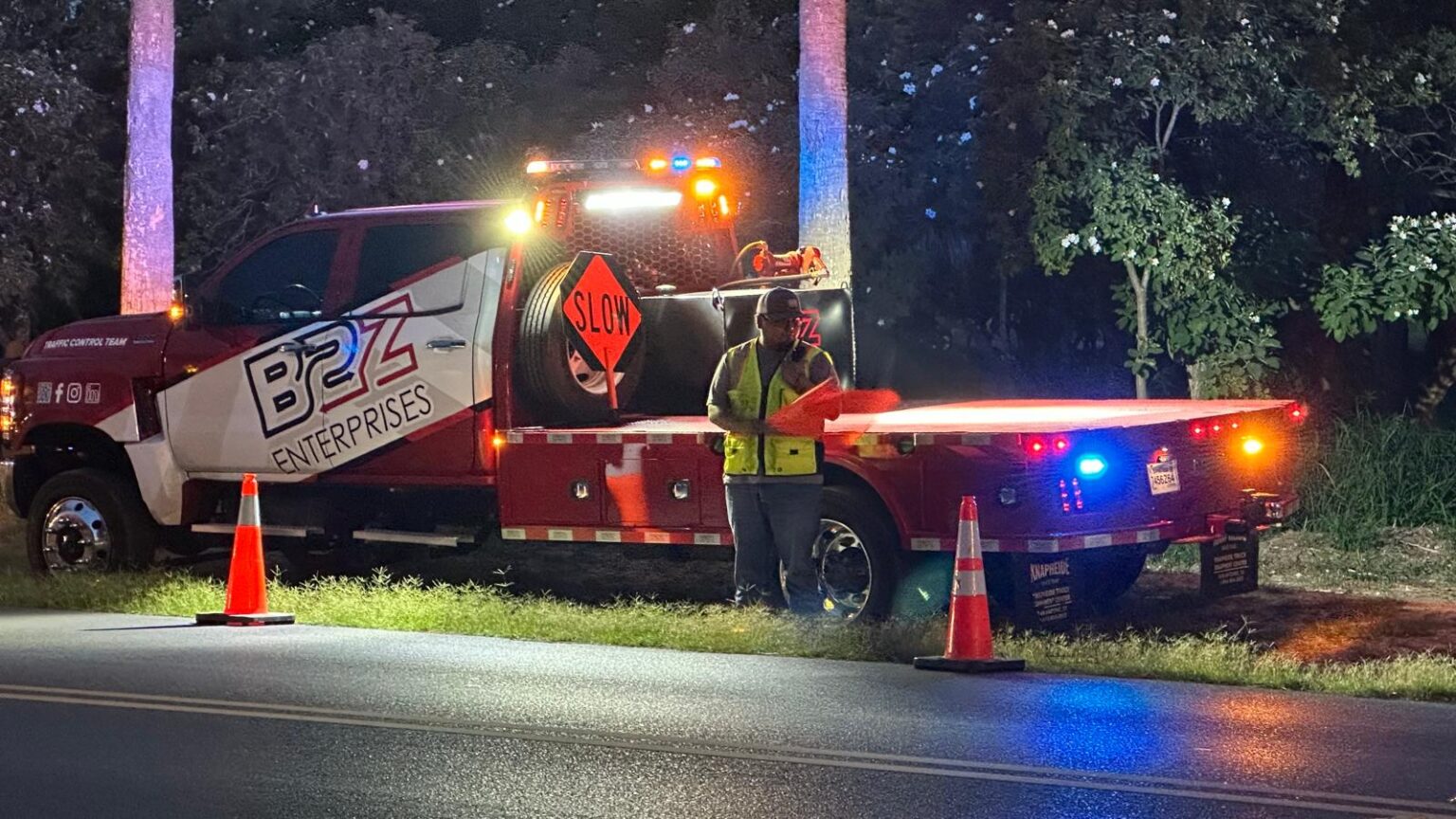
Flagging is one of the most visible parts of traffic control, but it’s also one of the most skill-dependent. A flagger has to communicate clearly with drivers, know when to release traffic, and stay alert for hours in all weather conditions. All of our flaggers are ATSSA-trained and carry current certifications. We deploy them on two-lane roads, multilane highways, and downtown intersections.
What flagging methods work best for San Antonio’s traffic patterns?
On high-speed roads like US 281 or I-10, we use the flagger-must-be-visible-at-all-times protocol, positioning flaggers at the transition taper where they can see approaching traffic and be seen. On lower-speed streets in neighborhoods like Alamo Heights or Southtown, we often use one-lane two-way flagging with a stop/slow paddle and a radio system between two flaggers. During peak hours, we adjust the timing to minimize delays, and we never leave a flagger station unmanned during active work.
What lane closure solutions do you offer?
We provide temporary lane closures for short-term (less than 1 hour), intermediate (1 hour to 1 day), and long-term (over 1 day) work zones. Each closure type uses different taper lengths—for example, a 45 mph road needs a taper of at least 540 feet according to MUTCD tables. We set up using Type I, II, or III barricades, with channelizing devices spaced according to speed. For night work, we add steady-burn lamps and reflective sheeting to all devices. We also install temporary rumble strips when needed to alert sleepy drivers.
Comparison table: Short-Term vs Long-Term Lane Closures
| Feature | Short-Term Closure (under 1 hour) | Long-Term Closure (over 1 day) |
|---|---|---|
| Typical use | Utility repair, tree removal, signal work | Road widening, pavement overlay, bridge repair |
| Advance warning | One set of signs 500-1000 ft upstream | Multiple sets at 1 mile, 1/2 mile, and 1/4 mile |
| Channelizing devices | Cones or plastic drums | Delineators or temporary barrier with reflective tape |
| Lighting | Not required if daytime | Steady-burn lamps on all devices, arrow board required |
| Permit needed | Often a same-day emergency permit | Full TTCP required with 7-14 day lead time |
| Cost per day (materials & labor) | $600 – $1,200 | $1,500 – $3,500 |
How Does B2Z Enterprises Handle Highway Maintenance and Work Zone Safety in San Antonio?
Highway maintenance work—things like pothole patching, guardrail repair, or sweeping—requires a different approach than new construction. The work zones are often mobile or short-duration, and the margins for error are razor-thin because traffic speeds are high. B2Z Enterprises has completed numerous highway maintenance contracts for TxDOT’s San Antonio District, maintaining safe work zones on I-35, I-410, US 90, and SH 151.
What equipment do you use for highway work zones?
We deploy trailer-mounted variable message boards (VMS) with custom messages like “ROAD WORK AHEAD” and “LANE CLOSED.” We also use advance warning arrow signs with high-intensity LEDs, crash cushions (truck-mounted attenuators), and temporary concrete barriers for long-term lane closures. All equipment meets TxDOT specifications and is inspected before every deployment. We also carry portable rumble strips for temporary use.
How do you ensure safety on high-speed work zones?
We follow TxDOT’s Work Zone Safety Standard Operating Procedures (SOP), which require a minimum of two advanced warning signs for speeds over 45 mph, a flagger station at the transition, and a shadow vehicle with an attenuator. We also hold a daily safety briefing with the entire crew before any work begins, covering topics like escape routes, communication signals, and weather conditions. In the past year, we have maintained a zero-major-incident record across all San Antonio highway projects.
San Antonio’s Texas A&M Transportation Institute (TTI) has published several studies on work zone crashes in urban areas—data shows that rear-end collisions account for over 30% of work zone crashes on urban interstates. That’s why we emphasize proper advance warning and taper lengths to give drivers time to react. We also work closely with the San Antonio Police Department to enforce reduced speed limits through active work zones.
What Sets B2Z Enterprises Apart from Other Traffic Control Providers in San Antonio?
There are several traffic control companies in the San Antonio region, but few offer the combination of local knowledge, full-service capability, and 24/7 availability that we do. We’re based in the Rio Grande Valley but we have a dedicated team that works San Antonio projects—our crews know the neighborhoods, the routes, and the quirks of each jurisdiction.
How does local knowledge make a difference?
When you’re working on a street like West Commerce near the Market Square, you have to account for pedestrian traffic from the historic market, delivery trucks for restaurants, and the occasional parade or event. We know that. When you’re closing a lane on Loop 410 near the airport, we know that flight schedules create peak traffic windows around 6 AM and 5 PM. We adjust our lane closure timing to avoid those windows, which keeps motorists happy and prevents complaints to the city.
What does full-service mean for a contractor?
We handle the entire lifecycle of a TTCP: initial consultation, site survey, plan design, permit submission, material delivery, setup, maintenance, and final teardown. If a sign gets knocked over or a cone runs out of reflective tape, we replace it within the hour. We also keep detailed records of every deployment for compliance audits. This means the contractor can focus on their core work without worrying about traffic control logistics.
Do you offer 24/7 support?
Yes. Construction in San Antonio doesn’t stop at 5 PM—many utility repairs and highway overlays happen at night to reduce traffic impact. Our dispatch line (956-585-3773) is answered around the clock, and we can mobilize a crew for an emergency within two hours. We also handle last-minute plan revisions if a field condition changes, such as an unexpected utility conflict or a weather delay.
For a deeper look at how temporary traffic control plans protect public safety in growing Texas communities, check out our article on Why TTCP traffic control plans in Brownsville Matters More Than Ever. And if you’re working on municipal utility projects, our guide on Why Brownsville Utility Projects Need Expert TTCP Traffic Control Plans offers insights that apply to San Antonio as well.
How Can San Antonio Contractors Get a Custom TTCP Quote from B2Z Enterprises?
Getting started is straightforward. You can visit our website at b2zenterprises.com and fill out the project request form, or call us at 956-585-3773 to speak with a traffic control specialist. We’ll ask for the basic details: location, type of work, expected duration, and any special requirements like night work or emergency response.
What happens after you submit a request?
Within 24 hours, one of our certified supervisors will schedule a free site assessment. We’ll walk the job site, take measurements, note existing conditions, and discuss your timeline. Then we’ll prepare a custom TTCP and a transparent quote that breaks down materials, labor, and coordination fees. Our pricing is competitive because we source materials directly from manufacturers and we maintain our own fleet of vehicles and equipment.
How fast can you deploy?
Once the plan is approved and you give the green light, we can typically have a crew on site within 48 hours for routine projects. For emergency situations, we aim for same-day mobilization. We keep a reserve of the most common traffic control materials—cones, signs, barricades, arrow boards—in our San Antonio staging area.
Do you handle demobilization?
Yes. After the project is complete, we remove all signs, cones, and barriers, patch any pavement marks, and restore the work zone to its original condition. We also file a completion notice with the permitting agency so you have no lingering obligations. Our goal is to make the entire traffic control process invisible to everyone except the contractors who depend on it.
Don’t see your question? We’re here to help.
Frequently Asked Questions About TTCP Traffic Control Plans in San Antonio
Do I need a TTCP for every construction project in San Antonio?
Not every project requires a full TTCP. Minor work that does not affect traffic—like sidewalk repairs behind a barrier—may only need basic cone setup. However, any time you close a lane, redirect traffic, or block a sidewalk, you need a plan. The City of San Antonio and TxDOT both require a TTCP for lane closures on any street with a speed limit over 30 mph. When in doubt, contact us for a free assessment.
How long does it take to get a TTCP approved in San Antonio?
For standard projects on city streets, the City of San Antonio Public Works Department typically takes 5 to 10 business days to review and approve a plan. TxDOT’s San Antonio District office usually needs 7 to 14 business days for state highway projects. Emergency permits can be obtained the same day if the work is urgent. B2Z Enterprises handles the entire submission and follow-up process, so you don’t have to chase down permitting staff.
What happens if a violation occurs in my work zone?
If a driver ignores signs or cones and enters the work zone, liability typically rests with the driver. However, if your TTCP was not properly set up or did not follow MUTCD standards, the contractor can be held partially liable. That’s why using a certified traffic control company like B2Z Enterprises is critical—we maintain compliance documentation for every job, proving that the work zone met all regulations at the time of the incident.
Can you handle night work in San Antonio?
Yes. Night work is common on highways like I-35 and I-10 to minimize daytime congestion. We provide reflective signage, steady-burn lamps, trailer-mounted arrow boards, and high-visibility apparel for all crew members. Night work zones require additional lighting and shorter taper lengths to account for reduced visibility, and our crews are trained specifically for those conditions.
Do you provide traffic control for special events?
Absolutely. San Antonio hosts numerous events—Fiesta, the San Antonio Stock Show & Rodeo, Alamodome concerts, and marathons—that require temporary road closures and detours. We design event-specific TTCPs that coordinate with the City of San Antonio’s Special Events Office and SAPD. We can provide flaggers, barricades, and signage for single-day or multi-day events.
How much does a TTCP cost in San Antonio?
Costs vary depending on project duration, complexity, and materials. A simple short-term lane closure for a day might cost $600 to $1,200 in materials and labor. A long-term highway lane closure could run $1,500 to $3,500 per day. We provide free, transparent quotes with no hidden fees. Because we manage our own supply chain, we often beat competitors’ prices while delivering higher-quality service.