
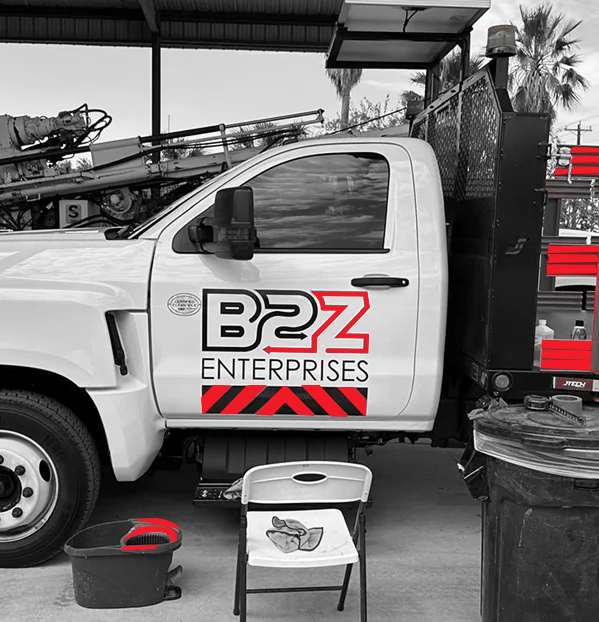
Flagging in Austin, Texas
Protect your property’s value with a straight, simple fix.
Skipping Flagging can cost you thousands. It’s not a dramatic statement. It’s a mechanical fact. When concrete or asphalt settles, cracks, or heaves, water finds its way in. That water does not stop. It freezes in winter, expands in summer, and washes out the base underneath. The result is a slab that tilts, a walkway that trips people, or a driveway that holds water instead of draining it. The fix gets more expensive every month you wait.
Flagging is the simple act of cutting a control joint into the surface. It gives the concrete a weak point so it cracks where you want it to crack, not where it decides to. It’s a cheap insurance policy. Think of it like changing the oil in your car. You can skip it for a while. The engine will run. But eventually, the sludge builds up, heat spikes, and you are looking at a full rebuild. A $50 oil change turns into a $5,000 engine. Flagging works the same way. A small investment now prevents a major headache later.
The problem is that most people don’t think about it until it’s too late. They pour a new driveway, patio, or foundation, and they assume it will stay perfect forever. It won’t. Concrete moves. It expands and contracts with temperature changes. It settles into the ground. Without a proper joint, the stress builds up until the concrete finds its own release. That release is almost always an ugly, jagged crack that runs straight through the middle of your investment.
Here is the straight talk: Flagging is not glamorous. It’s not something you show off to neighbors. But it is the difference between a surface that lasts twenty years and one that needs repair in three. It is the difference between a clean, professional finish and a mess that looks like a cheap patch job. If you are spending money on concrete, you are spending money on something that should hold up. Flagging makes sure it does.
We have seen it a hundred times. A homeowner pays for a beautiful stamped patio. Six months later, a hairline crack appears. A year later, it is wide enough to catch a heel. Two years later, water has undermined the whole thing. The cost to tear out and repour is triple what the original job was. All because someone skipped a $200 flagging step. That is not a bad luck story. That is a predictable outcome.
You do not have to be an expert to understand this. Think about a sidewalk that has been there for years. The ones that look good have straight, even lines cut into them. The ones that look bad have random cracks running every direction. The difference is Flagging. It is control. It is planning. It is doing the job right so the concrete behaves the way you want it to.
The return on investment is obvious. For a small fraction of the total project cost, you get peace of mind. You get a surface that stays level, drains properly, and does not become a safety hazard. You get a property that holds its value instead of losing it. If you are planning any concrete work in Austin, Flagging is not an optional extra. It is the difference between a job done right and a job you will regret.
Why Flagging Matters for Austin, Texas Residents
Austin has a specific climate that makes Flagging more than a good idea. It is a necessity. We get hot, dry summers and occasional hard freezes in winter. That temperature swing is brutal on concrete. The ground here is also a mix of clay and limestone. Clay expands when it gets wet and shrinks when it dries. That movement puts constant stress on any slab. Without proper joints, that stress has nowhere to go.
The humidity in Austin also plays a role. Moisture gets trapped under concrete and tries to escape. If it cannot, it pushes up from below. That is how you get heaving and uneven surfaces. Flagging gives the concrete a path to relieve that pressure. It keeps the surface flat and safe.
Many homes in Austin were built decades ago. Older concrete does not have the same reinforcement standards we use today. That makes it more prone to cracking. If you are adding a new patio, walkway, or driveway to an older property, Flagging is the smartest thing you can do. It ties the new work into the old and prevents differential settling. The result is a cohesive surface that looks like it was always there.
Local conditions matter. Flagging in Austin is not the same as Flagging in Seattle or Phoenix. We understand the soil, the weather, and the building styles here. That local knowledge means we cut joints at the right depth and spacing for our climate. It is not a one-size-fits-all approach. It is tailored to make your concrete last in this specific environment.
The Long-Term Value of Quality Flagging
The value of Flagging is best explained with an analogy. You go to the dentist for a cleaning. It costs a couple hundred bucks. You hate doing it. But you do it because you know a cavity will cost ten times more to fix and hurt a lot more. Flagging is the same thing. It is preventive maintenance that saves you from a bigger problem down the road.
Think about a driveway. You park your car on it every day. You walk on it. Your kids ride bikes on it. It takes a beating. Over time, that surface develops micro-cracks from thermal expansion. Without Flagging, those micro-cracks grow into macro-cracks. Water seeps in. The freeze-thaw cycle in winter makes them worse. Within a few years, you have a driveway that looks like a map of the interstate system.
Flagging gives the concrete a controlled place to crack. It is like scoring a piece of glass before you break it. The break happens where you want it to, not randomly. The same principle applies here. The joints are cut to a specific depth and pattern. When the concrete moves, it cracks along those lines. The result is a clean, straight line that is easy to maintain and looks intentional.
The financial return is straightforward. A typical Flagging job costs a fraction of what a concrete pour costs. If you are spending $5,000 on a new patio, adding Flagging might add $200 to $400. That is 4% to 8% of the total. If that patio lasts fifteen years instead of five, you have saved thousands in replacement costs. The math is not complicated.
There is also the aesthetic value. A properly flagged surface looks professional. It shows that someone cared about the details. When you sell your home, that matters. Buyers notice a cracked, uneven driveway. They might not know why it is bad, but they know it is a problem. A smooth, well-maintained surface with clean joints tells them the property was cared for. It adds to curb appeal and property value.
Safety is another factor. Uneven concrete is a tripping hazard. In Austin, where we have a lot of outdoor living space, that is a real concern. A cracked patio or walkway can catch a foot, especially for kids or older adults. Flagging keeps the surface level and safe. It is a small investment in preventing a trip to the emergency room.
The bottom line is simple. Flagging is not an expense. It is an investment in the longevity, safety, and value of your property. It is the kind of thing that pays for itself many times over. You will not notice it when it is done right. But you will definitely notice if it is not done at all.
Why We Are the Preferred Choice in Steiner Ranch
B2Z Enterprises started with a simple idea: give clients work they can stand behind. That idea still drives us. We are not interested in cutting corners or rushing through jobs. We are interested in results that hold up. Our reputation in Steiner Ranch and the greater Austin area is built on that principle.
We have been in this market long enough to know what works. We have handled complex jobs that other firms passed on. We have solved problems that stumped more established companies. And we have done it while keeping our commitments. When we give you a timeline, we stick to it. When we quote a price, that is what you pay. No surprises. No hidden fees.
Our team brings real experience to every project. We do not send out a crew that has never seen a concrete pour. We have people who understand the soil, the climate, and the local building codes. They know how deep to cut a joint in a Steiner Ranch driveway versus a downtown Austin sidewalk. That kind of knowledge comes from years of doing the work, not from reading a manual.
What sets us apart is how we communicate. We do not disappear after the estimate. We stay in touch. We show up prepared. We take pride in the details that others overlook. Our clients notice the difference. They see it in the quality of the finish. They feel it in how we handle their property. They hear it in the referrals they give their neighbors.
We are proud of what we have built. But we are prouder of the relationships that came with it. Every project adds to our experience. Every client adds to our reputation. And every job we finish adds to the trust this community has placed in us. That trust matters. We have earned it one project at a time, and we protect it with every decision we make.
If you are in Steiner Ranch or anywhere in the Austin area, you deserve a contractor who treats your property like their own. That is what we offer. Straight talk, solid work, and a commitment to doing it right the first time. Let us show you the difference.
🚩 Signs You Might Need Flagging (Don’t Panic – Just Check)
- You notice a hairline crack in a new driveway or patio within the first year.
- Water pools on your concrete surface after a rain instead of draining off.
- You feel a slight lip or unevenness when walking across a slab.
- It has been more than five years since the concrete was poured and no joints were cut.
Find Us in Austin, Texas
Expert FAQ

TEXAS STATEWIDE MOBILITY
MISSION
900 S. Stewart Rd. Ste 12
Mission, TX 78572
BROWNSVILLE
185 Billy Mitchell Boulevard
Brownsville, TX 78521
SAN ANTONIO
12746 Cimarron Path STE C152
San Antonio, TX 78249
AUSTIN
4707 Commercial Park Drive
Austin, TX 78724
HOUSTON
13250 Forkland Drive
Houston, TX 77077
CONTACT US:

©2026 B2Z Enterprises. All Rights Reserved.
TEXAS STATEWIDE MOBILITY
900 S. Stewart Rd. Ste 12
Mission, TX 78572
BROWNSVILLE
185 Billy Mitchell Boulevard
Brownsville, TX 78521
SAN ANTONIO
12746 Cimarron Path STE C152
San Antonio, TX 78249
AUSTIN
4707 Commercial Park Drive
Austin, TX 78724
HOUSTON
13250 Forkland Drive
Houston, TX 77077
CONTACT US:
©2026 B2Z Enterprises. All Rights Reserved.