Hello from B2Z Enterprises! 👋
How B2Z Enterprises Provides Expert Flagging Services for San Benito’s Road Construction Zones — Comprehensive Guide
In the Rio Grande Valley, a single misdirected car through a work zone can cause an average of $10,000 in delays per hour, according to TxDOT studies. That’s the cost of one wrong turn, one missing flagger, one faded sign. For communities like San Benito, where road construction projects are a constant backdrop to daily life, ensuring traffic keeps moving safely isn’t just a convenience—it’s an economic necessity. That’s where expert flagging services come in, and that’s why B2Z Enterprises makes work zone safety our single-minded focus.
San Benito sits at the crossroads of major corridors like Expressway 77/83 and numerous arterial roads. When those roads get reconstructed, resurfaced, or widened, motorists face confusion, delays, and danger. Without proper flagging, the entire operation grinds to a halt—or worse, someone gets hurt. Our team at B2Z Enterprises has been delivering TxDOT-compliant traffic control across the Valley for years, and we’ve seen firsthand what happens when flagging is treated as an afterthought.
📞
Hey there! Need help in McAllen, TX
Edinburg, TX
Pharr, TX
San Juan, TX
Alamo, TX
Donna, TX
Weslaco, TX
Mercedes, TX
Harlingen, TX
San Benito, TX
Brownsville, TX
Rio Grande City, TX
Roma, TX
La Joya, TX
Palmview, TX?
We’re your neighbors at B2Z Enterprises — always happy to chat!
If you’re planning a road construction project in San Benito—whether it’s a simple utility cut or a multi-phase highway rebuild—flagging services aren’t optional. They’re the front line of safety. In this guide, we’ll walk through everything you need to know about flagging, from the federal regulations that govern it to the practical realities of managing traffic on a busy San Benito street. You’ll learn what makes a flagger truly qualified, how to plan for lane closures, and why B2Z Enterprises is the go-to traffic control company for contractors, municipalities, and utility crews throughout the Rio Grande Valley.
What Are Flagging Services and Why Do They Matter?
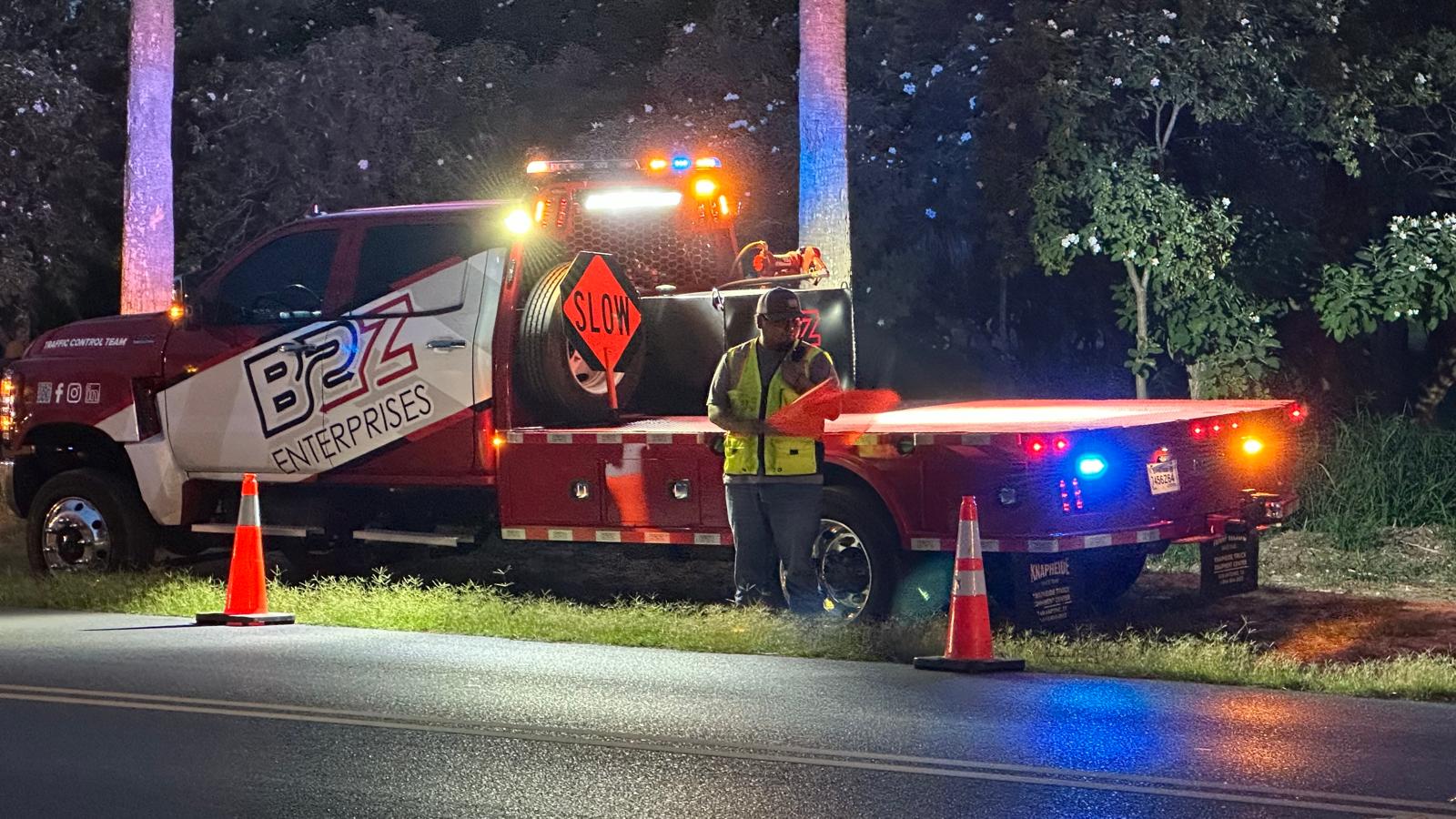
Flagging services involve trained personnel who direct vehicular and pedestrian traffic safely through or around a work zone using hand signals, paddles, and sometimes two-way radios. The role of a flagger is defined by the Manual on Uniform Traffic Control Devices (MUTCD), specifically Part 6E, which outlines the proper flagging procedures, equipment, and training requirements. Flaggers are not just “people with a stop sign.” They are the human element of a temporary traffic control plan (TTCP) and often the most visible—and most critical—component of work zone safety.
The Federal Highway Administration (FHWA) notes that work zone crashes killed 857 people in 2022 alone, with many of those incidents involving a failure to properly control traffic. Flagging services directly counteract those risks. A skilled flagger can reduce vehicle speeds, prevent rear-end collisions, and protect workers who are only feet away from moving traffic.
For San Benito, where projects like the recent Expressway 77/83 overpass improvements have disrupted traffic patterns for months, flagging services ensure that local businesses remain accessible, emergency vehicles can get through, and commuters don’t face impossible delays. Without flagging, you get chaos. With it, you get controlled, predictable traffic flow that keeps the project on schedule and the public safe.
TxDOT Compliance: The Gold Standard for Flagging in Texas
Every flagging service we provide at B2Z Enterprises meets or exceeds TxDOT standards. That’s not just a boast—it’s a requirement for any contractor working on Texas roadways. TxDOT’s Work Zone Safety guidelines incorporate the MUTCD and add specific state-level requirements for everything from flagger attire (high-visibility ANSI Class 3 vest and hard hat) to the timing of lane closures during peak hours.
One of the most important TxDOT rules is that all flaggers must be trained and certified under the Texas Flagger Training program, often delivered through providers like the American Traffic Safety Services Association (ATSSA). We ensure every member of our flagging crew holds current ATSSA certification and has passed a hands-on competency evaluation. We don’t hire untrained day laborers for flagging—ever. It’s a liability risk and a safety hazard we refuse to take.
Furthermore, the Occupational Safety and Health Administration (OSHA) requires that flaggers be “adequately trained” under 29 CFR 1926.201, with specific reference to the MUTCD. Our flagging services are fully compliant with both TxDOT and OSHA, meaning that when you hire B2Z Enterprises, you get a crew that passes any inspection—state or federal.
Flagging in San Benito: Local Challenges and Solutions
📞
Got questions about Highway Maintenance Traffic Control?
No worries! B2Z Enterprises is just a call away. We love helping our neighbors.
San Benito’s road network presents unique challenges. The city lies along US 77/83, a high-speed divided highway that carries significant freight and commuter traffic. But it also has narrow residential streets, aging infrastructure, and a growing population that demands constant maintenance. When a water main breaks on a busy street like Sam Houston Boulevard, we have to flag traffic through a tight work zone while keeping access open for homes and businesses. That requires quick decision-making and clear communication.
For example, a recent project on Sam Houston Boulevard involved replacing a 12-inch water main for the San Benito Water Department. The work required trenching across one lane of a two-lane road, leaving only one lane for alternating traffic. Our flagging crew set up a pilot-car operation with flaggers at both ends, managing 15-minute alternating intervals during off-peak hours. The result? The road was restored to two-lane traffic every evening, and no accidents occurred during the entire two-week project.
Flagging in San Benito also means dealing with special events and school zones. The city hosts the annual San Benito Festival and has multiple schools along major corridors. We always coordinate with local law enforcement and school district officials to adjust flagging protocols during drop-off and pickup times. It’s the kind of local knowledge you can’t get from a national traffic control provider—it comes from living and working in the Valley.
How Flagging Integrates with MOT Plans and TTCPs
Flagging services don’t exist in a vacuum. They are a critical part of a larger Maintenance of Traffic (MOT) plan or a Temporary Traffic Control Plan (TTCP). Before a single cone is placed, we work with the general contractor or municipal engineer to design a TTCP that specifies the taper lengths, sign placement, advance warning distance, and flagger station locations. Every element is calculated based on road speed, volume, and geometry using the MUTCD’s tables and formulas.
Want results like this? B2Z Enterprises can help.
MOT plans for larger projects, like the ongoing widening of FM 1425 south of San Benito, require flagging to be coordinated with multiple crews, multiple closure phases, and even temporary detours. Our team at B2Z Enterprises works with TxDOT area engineers to ensure that every phase of the MOT plan has adequate flagging coverage—including overnight flagging when needed. We’ve handled 24-hour flagging operations for highway maintenance projects in the middle of summer heat, rotating crews every two hours to maintain alertness and safety.
Training and Certification: What Makes a B2Z Flagger Different
You might wonder: isn’t flagging just holding a sign? No. A professional flagger must understand traffic dynamics, know when to switch between “stop” and “slow” based on queue length, and be able to communicate with workers inside the work zone and with motorists. They must also recognize hazards like impaired drivers, speeding vehicles, or equipment blind spots.
Our flagging crew undergoes initial ATSSA training and annual refreshers. We also conduct weekly toolbox talks specific to the project they’re working on. For instance, if the utility crew is using a vacuum excavator that produces loud noise, our flaggers know to rely on hand signals and radio protocols rather than voice commands.
We also require flaggers to be certified in CPR and first aid, and to carry a personal flotation device if flagging near water (like the bridge projects along 77/83). This level of preparation isn’t mandated by TxDOT—but it’s our standard. We’ve had multiple instances where a flagger’s first aid training prevented a minor cut from becoming an infection. That’s the kind of care we bring to every job.
Flagging Services for Different Project Types
Utility Installation Traffic Control
When a utility company needs to install fiber optic cable, replace a gas main, or repair a sewer line in San Benito, they need temporary traffic control that can be set up quickly and removed just as fast. Our flagging services for utility work emphasize minimal disruption. We typically use a single flagger on each end of the work zone for alternating traffic, with portable traffic signals for longer-duration projects. We understand that utilities have tight excavation windows and need their flagging team ready at a moment’s notice. That’s why we offer same-day service for emergency break repairs.
Highway Maintenance Traffic Control
TxDOT regularly schedules maintenance activities like crack sealing, sign repair, and shoulder work on highways through San Benito. These projects often involve moving operations—the work zone advances down the road as crews work. Flagging for moving operations requires a different approach: we use “mobile flagging” where the flagger actually moves with the work zone, coordinating with pilot cars and advance warning vehicles. Our flaggers are trained to handle this dynamic setup while maintaining safe stopping sight distances.
Construction Zone Safety for Development Projects
As San Benito grows, new housing developments and commercial centers are popping up along corridors like Business 77. These projects often require a flagging company to manage traffic during site access construction, curb and gutter work, and final paving. We’ve flagged for multiple large subdivisions in the S.H. 345 area, managing the interface between construction trucks and the public. Our flaggers keep the construction trucks moving efficiently while protecting school buses and locals who use those roads daily.
The Role of Technology in Modern Flagging Services
While flagging itself is a manual task, technology supports it. We use two-way radios with earpieces for clear communication between flaggers and pilot car drivers. For longer work zones, we deploy portable traffic signal trailers that can be synchronized with flagger stations. We also use drone footage in our planning phase to identify sight-distance issues before the first cone goes down. That’s a service we offer as part of our comprehensive work zone safety solutions—aerial imagery of the site helps us design safer TTCPs. This is especially useful for San Benito’s winding rural roads where trees or utility poles can block a flagger’s view.
Common Flagging Mistakes We See—And How We Avoid Them
- Inadequate advance warning. Many contractors skimp on signs, placing them too close to the work zone. The MUTCD requires advance warning signs at specific distances based on speed. At 50 mph, the first sign should be 500 feet before the work zone. We always measure and verify.
- Using untrained personnel. We’ve seen general laborers handed a stop sign with zero training. That’s illegal and dangerous. Our flaggers have completed ATSSA training and carry their certification cards on every job.
- Poor flagger positioning. A flagger should stand in the closed lane, not the open lane, to avoid being hit. They should also have an escape path. Our supervisors inspect positioning daily.
- No communication with the work crew. Flaggers need to know when the crew is about to move equipment across the road. We integrate flagging into the daily pre-work huddle.
- Ignoring nighttime flagging requirements. Flagging at night requires retroreflective gear and illuminated paddles. We provide them as standard.
Why San Benito Contractors Trust B2Z Enterprises
We’re a TxDOT-certified traffic control company based at 900 S. Stewart Road. Ste 12, Mission, TX. That central location lets us reach San Benito in under 30 minutes. When a contractor calls at 6 a.m. needing flagging for an emergency water line repair, we can have a crew on site by 7:30. That responsiveness builds trust.
Our team has deep ties to the Rio Grande Valley. We understand the language, the culture, and the driving habits unique to our region. We know that a flagger standing in the middle of Expressway 77/83 will encounter drivers unfamiliar with merge laws, so we teach our flaggers to be extra patient and use high-visibility gestures. We also know the local school bus routes and adjust flagging to avoid holding up buses.
When you choose B2Z Enterprises, you’re not just hiring a flagging company—you’re partnering with a firm that has completed hundreds of projects across McAllen, Edinburg, Pharr, Donna, Weslaco, Mercedes, Harlingen, San Benito, Brownsville, and beyond. Our reputation is built on zero-accident records and on-time project completions. We’re proud to have earned a 4.9/5 rating from our Google reviews, with clients specifically praising our flaggers’ professionalism and promptness.
Our flagging services are backed by comprehensive liability insurance and compliance with all TxDOT, FHWA, and OSHA regulations. We provide certificates of insurance and compliance documentation upon request. You can rely on us to pass any site inspection without issue.
Frequently Asked Questions About Flagging Services
How many flaggers do I need for a typical lane closure in San Benito?
For a standard lane closure on a two-lane road (one lane open for alternating traffic), you typically need two flaggers—one at each end of the work zone. For higher-speed roads like US 77/83, we also recommend a pilot car driver. Our team at B2Z Enterprises provides a free site assessment to determine the exact number required for your specific project based on traffic volume and sight distance.
Are your flaggers ATSSA certified?
Yes, every flagger we deploy holds current certification from the American Traffic Safety Services Association (ATSSA) or an equivalent TxDOT-approved program. We also conduct internal monthly refresher training. You can request copies of certifications before we start any job.
Can you provide flagging for after-hours or overnight work?
Absolutely. We offer 24/7 flagging services seven days a week. Nighttime flagging requires additional lighting and retroreflective PPE; we provide all equipment. Many San Benito water and sewer repairs are done overnight to minimize traffic impact, and we’re available for those calls.
How far in advance do I need to book flagging services?
For planned projects, booking at least 48 hours in advance helps us guarantee availability. For emergency utility repairs, we can often dispatch a crew within 2 hours. Call 956-585-3773 to check immediate availability. Our dispatch team works with you to prioritize urgent needs.
Do you provide traffic control equipment (cones, signs, barriers) along with flagging?
Yes. As a full-service traffic control company, we supply all required temporary traffic control devices—cones, drums, barricades, signage, arrow boards, and portable traffic signals—as part of our flagging service package. You don’t need to rent equipment separately. We deliver, set up, maintain, and remove everything.
How do you handle flagging on high-speed highways like US 77/83?
High-speed roads require longer advance warning distances, larger signs, and greater taper lengths. We use MUTCD Table 6C-1 to calculate the correct spacing. Flaggers are positioned in closed lanes with escape routes, and we use two-way radios for coordination. We also install temporary rumble strips and speed reduction signs where appropriate. Our flagging crew has extensive experience on high-speed corridors throughout Hidalgo and Cameron counties.
Planning Your San Benito Road Construction Project? Start with Flagging
Whether you’re repairing a water main on Sam Houston Boulevard, widening FM 1425, or building a new subdivision entrance off Business 77, reliable flagging services are the foundation of work zone safety. The National Work Zone Safety Information Clearinghouse reports that properly managed traffic control can reduce work zone crashes by up to 40%. That’s not just a statistic—it’s a lifesaver.
At B2Z Enterprises, we bring a technical, no-shortcuts approach to every flagging job. We don’t cut corners on training, equipment, or compliance. Our team lives in the communities we serve, and we care about the safety of your workers and the driving public. From our base at 900 S. Stewart Road. Ste 12, Mission, TX, we cover the entire Rio Grande Valley with rapid response and professional expertise. Reach our dispatch at 956-585-3773 to discuss your next project’s flagging needs. We’re ready to help you keep San Benito moving—safely and efficiently.
🤝
Let’s Work Together!
B2Z Enterprises is ready to help. Find us at 900 S. Stewart Road. Ste 12, Mission, TX, 78572 or give us a shout!