
Local Guide
Why MOT Plans in Roma, TX Matter More Than Ever
If you’re planning road work, utility installation, or highway maintenance in Roma, TX, a professionally designed Maintenance of Traffic (MOT) plan isn’t optional paperwork—it’s the difference between a project that runs safely and on schedule and one that creates hazards, draws fines, and damages your reputation. A Temporary Traffic Control Plan (TTCP) compliant with TxDOT and federal MUTCD standards ensures worker safety, public protection, and project efficiency on Roma’s uniquely challenging road network.
What Exactly Are MOT Plans and Why Do They Require a Specialist in Roma, TX?
MOT plans are detailed engineering documents that dictate how traffic will be safely managed around a construction or maintenance work zone. They specify lane closure configurations, signage placement, flagger protocols, temporary barrier locations, and pedestrian routing. In Roma, these plans must account for dozens of local variables that generic templates from Houston or Dallas simply don’t address.
Roma’s road network presents specific challenges. US-83 cuts directly through town, carrying heavy commuter traffic, school buses, and commercial trucks accessing the Roma International Bridge. The narrow residential streets near the old downtown plaza, combined with multiple school zones along FM 650, require precise timing and placement of traffic control devices. Add in seasonal agricultural traffic during citrus and vegetable harvests, and you have a traffic environment that demands local expertise.
Every MOT plan in Texas must comply with the Texas Manual on Uniform Traffic Control Devices (TxMUTCD), which aligns with federal standards set by the US Department of Transportation. TxDOT district engineers in Pharr review and approve all plans for state roadways in Roma. A specialist who has worked with that district office—who knows their specific expectations for channelizing devices, taper lengths, and advance warning sign spacing—gets plans approved faster and avoids costly revision cycles.
Edinburg, TX
Pharr, TX
San Juan, TX
Alamo, TX
Donna, TX
Weslaco, TX
Mercedes, TX
Harlingen, TX
San Benito, TX
Brownsville, TX
Rio Grande City, TX
Roma, TX
La Joya, TX
Palmview, TX
956-585-3773
As a TxDOT-certified traffic control company operating out of Mission, TX, B2Z Enterprises brings exactly this local regulatory knowledge. Our team has prepared and executed dozens of MOT plans along Roma’s key corridors, including the high-traffic stretch of US-83 near the Roma High School campus. We don’t copy and paste plans from other cities—we design each TTCP to fit Roma’s actual road geometry and traffic patterns.
How Do MOT Plans Impact Safety for Workers and Drivers in Roma?
The numbers are sobering. According to the Texas Department of Transportation, work zone crashes in rural border communities have been rising steadily over the past five years. In Starr County alone, multiple incidents in 2023 and 2024 involved vehicles striking construction workers or crashing into properly placed barriers. The fatality rate in Texas work zones remains stubbornly high, with speeding and driver inattention as leading causes.
On US-83, where traffic frequently exceeds posted speed limits, a work zone without proper advance warning and taper zones is a recipe for disaster. The same applies to FM 650 near the Roma ISD Transportation Department—when school buses are loading and unloading, any disruption to predictable traffic flow creates immediate risks for children.
A professionally designed MOT plan mitigates these risks through several layers of protection:
- Advance warning signs placed at distances calculated for Roma’s actual speed limits and sight lines, giving drivers adequate time to react
- Buffer zones that separate workers from live traffic lanes using cones, barrels, or temporary barriers
- Flagging protocols that specify hand signals, paddle usage, and radio communication procedures for controlling alternating one-way traffic
- Lane closure timing that avoids peak school bus hours (7:00–8:30 AM and 3:00–4:30 PM) on routes serving Roma Elementary and Veterans Memorial High School
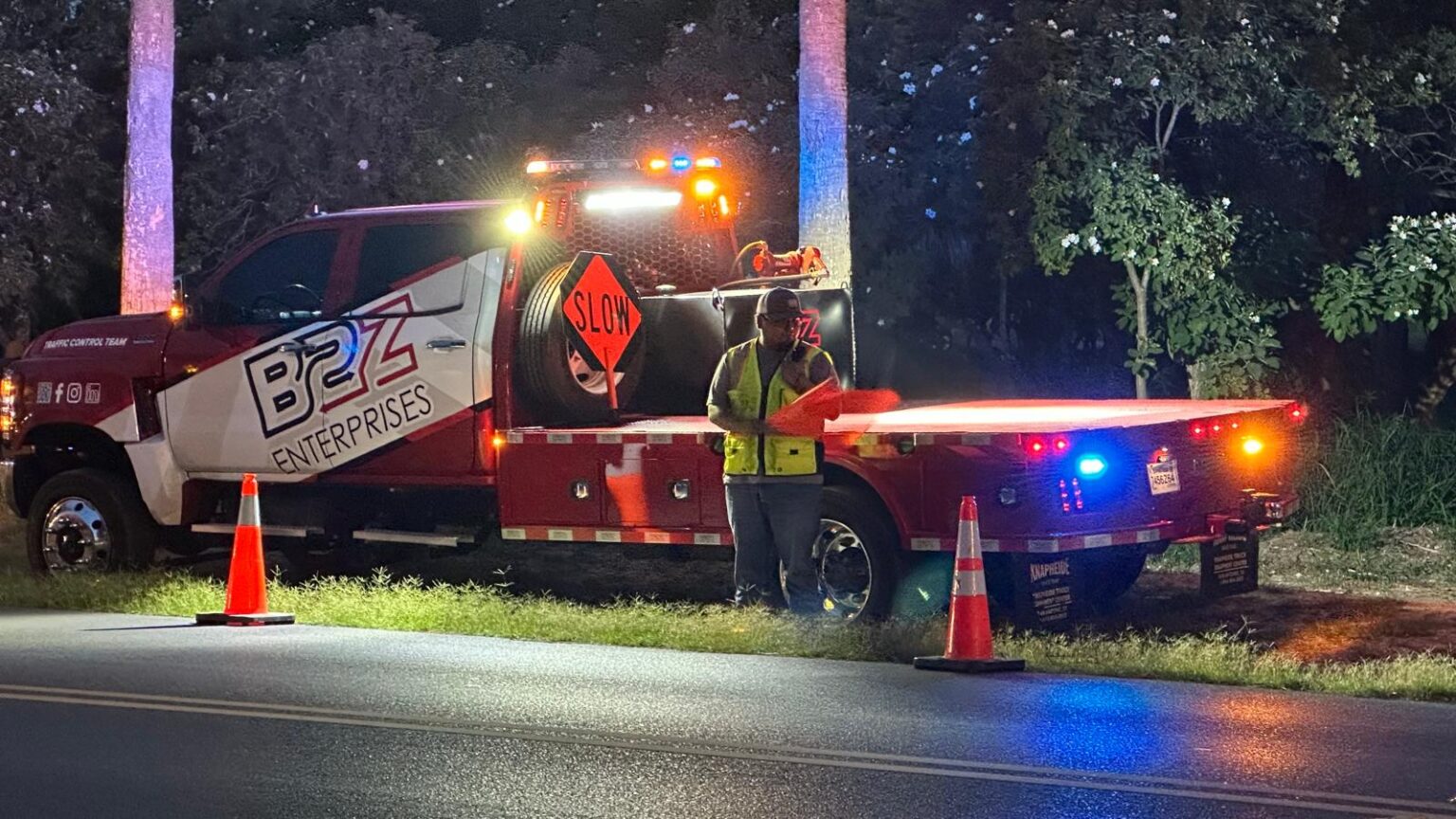
Our flagging services crews at B2Z Enterprises are trained to ATSSA (American Traffic Safety Services Association) standards and carry current certifications. We conduct daily pre-work safety briefings that review the specific hazards of each Roma job site. When we set up lane closures on US-83 for a highway maintenance project, our flaggers are positioned at distances that create a visible, predictable transition zone—not a sudden bottleneck that causes panic braking.
Why Are MOT Plans Critical for Utility Installation and Highway Maintenance in Roma?
Roma’s infrastructure is aging and expanding simultaneously. New fiber-optic lines are being buried along roadsides to improve internet access. Gas and water utility companies are replacing old mains throughout the community. These projects often involve open trenches that cross driveways, sidewalks, and travel lanes. Without a detailed MOT plan, a simple utility trench becomes a dangerous obstacle course for drivers and pedestrians.
Consider a typical scenario: a utility contractor needs to install a new water service line across US-83 near the Roma Post Office. The work requires a trench four feet wide and eight feet deep, disrupting one northbound lane. Without a plan, the crew might block the lane without proper taper distances, causing southbound drivers to slow abruptly and creating a rear-end collision risk. With a B2Z Enterprises-designed MOT plan, that same job uses a 500-foot advance warning zone, a 150-foot taper of channelizing devices, and two trained flaggers—one controlling each direction—to keep traffic moving safely at reduced speeds.
During highway shoulder maintenance on US-83, proper traffic control is even more critical. Shoulder work near the Roma International Bridge approach creates immediate conflicts with entering and exiting bridge traffic. Our team coordinates with Webb County and TxDOT district engineers to ensure that temporary lane shifts are clearly marked and that no work zone encroaches into the turning radius for the heavily used commercial truck route.
Case example: A utility contractor working on a fiber-optic installation project along Farm-to-Market Road 650, directly in front of Roma High School, came to B2Z Enterprises because their previous traffic control provider had set up signs too close to the work area, giving drivers virtually no reaction time. Our team redesigned the TTCP, extending advance warning signs to 800 feet in both directions, adding temporary rumble strips to alert distracted drivers, and scheduling pipe-burying operations during the 9:00 AM to 2:00 PM window when school traffic was minimal. The project finished three days ahead of schedule, with zero incidents or complaints from the school district. The contractor gained approval from Roma ISD Transportation for future work based on that performance.
Want results like this? B2Z Enterprises can help.
What Happens When a Project Skips Professional MOT Planning in Roma?
The consequences fall into three categories, all of them expensive.
Fines and citations. TxDOT and local law enforcement actively patrol work zones in Roma. An inspector can issue a citation for missing signage, improperly placed cones, or unqualified flaggers. These fines start at several hundred dollars and escalate for repeat violations. In one case we assisted with, a contractor on a small utility job near the Roma Fire Station received three separate citations in a single morning for missing taper devices, inadequate advance warning signs for the 40 MPH zone, and failure to provide a written TTCP on site.
Liability claims. If a driver crashes into a poorly marked work zone, or a worker is struck by a vehicle because flagging protocols were inadequate, the contractor faces legal liability. Medical bills, vehicle damage, lost wages, and pain-and-suffering claims can easily exceed six figures. Insurance carriers for unplanned work zones often deny coverage when basic safety standards were ignored.
Reputation damage. Roma is a tight-knit community. Word travels fast when a contractor creates traffic chaos. A project that snarls traffic for hours near the Roma High School campus or blocks access to the H-E-B grocery store generates complaints on local social media groups and in person at city council meetings. Contracts are awarded based on trust, and contractors known for sloppy work zones find themselves excluded from future bids.
The worst-case scenario we’ve seen involved a night-time lane closure on US-83 near the intersection with FM 650. A contractor without a proper MOT plan blocked both northbound lanes without any advance warning signs visible from 500 feet away. A driver cresting the slight hill near the old Roma Hotel site encountered the blockage at 60 MPH, swerved into the southbound lane, and narrowly missed a head-on collision. The resulting investigation halted the project for two weeks while TxDOT reviewed the contractor’s safety protocols. B2Z Enterprises was brought in to design and implement a compliant plan that allowed the work to resume—but the damage to the contractor’s reputation was permanent.
Proactive planning with a company like B2Z Enterprises avoids all of this. We handle the permitting process, design the plan to meet TxDOT and MUTCD standards, and provide on-site supervision to ensure every element is executed correctly.
How Does B2Z Enterprises Tailor MOT Plans to Roma’s Unique Conditions?
Local knowledge is the foundation of effective traffic control in Roma. Our team understands that this community is not a generic Texas border town—it has specific rhythms and constraints that must be respected.
Seasonal events and agricultural traffic: During citrus harvest season, farm trucks use Roma’s roads daily, often on short notice. Our plans build in extra buffer time for farm vehicle entry and exit from groves along US-83. During the annual Roma Fest celebration, we coordinate with city officials to adjust lane closures around parade routes and foot traffic.
School zones: Roma has multiple school campuses clustered along FM 650, including Roma High School, Roma Middle School, and several elementary campuses. Our MOT plans for projects near these schools automatically restrict certain types of work (milling, open trenches, heavy equipment movement) to specific hours outside of bus schedules. We’ve developed a working relationship with the Roma Independent School District Transportation Department to coordinate flagging operations around bus routes.
International bridge traffic: The Roma International Bridge connects to Ciudad Miguel Alemán, Mexico. Commercial trucks and passenger vehicles cross throughout the day and night. Any work within half a mile of the bridge approach requires special coordination with U.S. Customs and Border Protection and the bridge authority. Our TTCPs for those locations include contingency plans for backup scenarios that could affect border crossing operations.
Custom plan types: We design short-duration TTCPs for pothole repairs or utility locates that can be set up and removed within hours, and multi-week plans for major utility installations or highway resurfacing projects. Each plan includes a site-specific safety assessment, traffic volume projections, and contingency routing for emergencies.
Our 24/7 flagging services capability means we can respond to emergency utility repairs in Roma at 2:00 AM, set up a full work zone on US-83 within 45 minutes, and stay on site until the repair is complete and the road is fully reopened. That reliability has made us the go-to provider for Roma’s utility contractors.
We collaborate directly with top local providers of MOT plan services in Roma to ensure seamless coordination across projects. When a gas utility emergency required an immediate lane closure during morning rush hour at the intersection of US-83 and Main Street, our team coordinated with the Roma Police Department and TxDOT’s Pharr district office to get approval within 90 minutes and had a full TTCP operational by 6:30 AM.
When Should You Request a Traffic Control Plan for Your Project in Roma?
The trigger point is simpler than many contractors think: any work within 10 feet of a travel lane requires a documented traffic control plan. That includes utility repairs, median work, sidewalk repairs, shoulder grading, and of course any work that actually blocks a lane.
Specific trigger situations in Roma include:
- Night work: Reduced visibility demands extra signage, lighting, and reflective devices. TxDOT requires a separate night-time addendum to any TTCP.
- Reduced speed zones: Temporarily lowering speed limits through a work zone requires approved signage and, in some cases, law enforcement presence.
- Pedestrian pathway disruption: Any work blocking sidewalks near downtown Roma businesses or school routes requires pedestrian detours within the TTCP.
- Work within bridge clearances: Any work near the Roma International Bridge or smaller bridges over the Rio Grande requires special permits and plan approval from the bridge authority.
Timeline: Submit your project details to us at least two weeks before the planned start date. This allows time for site assessment, plan drafting, and TxDOT or city approval. Emergency projects are accelerated through our 24/7 response system, but routine planning benefits from the full timeline.
We provide ongoing support throughout the project lifecycle: on-site adjustments if traffic patterns shift, daily traffic logs for compliance documentation, and immediate incident response if a vehicle strikes a barrier or sign. When a contractor working on a TxDOT-compliant MOT plan for highway maintenance near Roma needed to adjust lane closure timing mid-project due to unexpected school bus route changes, our team was on site within the hour to reconfigure the work zone.
Here’s a practical comparison of using professional MOT planning versus attempting a self-managed approach:
| Factor | Professional MOT Plan (B2Z Enterprises) | Self-Managed / Generic Plan |
|---|---|---|
| TxDOT approval time | 3–5 business days (pre-submitted relationships) | 10+ business days (first-time submissions often rejected) |
| Liability protection | Fully insured, TxDOT-compliant documentation protects contractor | Gaps in compliance create liability exposure |
| Flagging crew training | ATSSA-certified, bilingual, experienced in Roma traffic patterns | Often untrained temporary laborers hired day-of |
| Local coordination | Established relationships with Roma PD, TxDOT Pharr, Roma ISD | No local contacts; delays in emergency approvals |
| Cost of revisions | Included in service (we adjust until plan works) | Each revision cycle costs billable hours and delays |
| On-site problem resolution | 24/7 response; team within 30 minutes of Roma | Often no support until next business day |
How to Choose the Right MOT Plan Provider for Your Roma, TX Project?
Not all traffic control companies are equally equipped to handle Roma’s specific conditions. Here are the red flags to watch for and the qualifications to demand.
Red flags:
- Generic plans: If a provider shows you a TTCP that was clearly designed for a wide suburban highway in Dallas or Houston, they don’t understand Roma. The lane widths, turning radii, sight distances, and traffic compositions are completely different.
- Underqualified flaggers: Ask for current ATSSA certifications. If the crew isn’t trained to national standards, your project is at risk.
- No local references: A company that can’t name three projects they’ve completed in Roma or Starr County doesn’t have the local knowledge you need. Ask for references from contractors who have worked on US-83 or near the Roma High School campus.
- No insurance documentation: Any legitimate traffic control provider carries general liability insurance and workers’ compensation coverage. Demand certificates of insurance before work begins.
B2Z Enterprises differentiators:
- Local presence: Based at 900 S. Stewart Road. Ste 12, Mission, TX, our team is 25 minutes from downtown Roma. We can be on site for emergencies or site assessments within 30 minutes.
- Bilingual crew: Spanish-language flagging and communication with Spanish-speaking construction crews and community members is standard, not an add-on service.
- 24/7 availability: Call us at 956-585-3773 any time, day or night, for emergency traffic control needs in Roma.
- Proven Roma experience: We’ve managed traffic for utility installations along FM 650, highway shoulder maintenance on US-83, and emergency line repairs near the Roma International Bridge. We know the roads, the traffic patterns, and the regulatory landscape.
Checklist before hiring a provider:
- Verify ATSSA certifications for all planned flaggers
- Request copies of past TTCPs for projects in Roma or similar border communities
- Confirm insurance coverage (general liability minimum $1M, workers’ compensation)
- Ask for contact information for the specific TxDOT district inspector they work with
- Get a timeline for plan submission and approval (should be under one week for standard projects)
- Ask about emergency response procedures if a work zone is hit by a vehicle or a sign is knocked down
We offer a free initial consultation for Roma contractors and project owners. During that consultation, we assess your project scope, review your timeline, and provide a preliminary TTCP cost estimate. No obligation, no pressure—just professional guidance on what your project requires to stay safe, compliant, and on schedule.
More questions? B2Z Enterprises has answers.
Frequently Asked Questions About MOT Plans in Roma, TX
What is the difference between an MOT plan and a TTCP?
In practice, the terms are often used interchangeably. Maintenance of Traffic (MOT) plan is the broader term used by TxDOT and many construction contractors. Temporary Traffic Control Plan (TTCP) is the specific document that details every element of the work zone: signage types and locations, channelizing device spacing, flagger positions, taper lengths, buffer zones, and pedestrian detours. A TTCP is the executable version of an MOT plan.
How long does TxDOT take to approve an MOT plan for a Roma project?
Standard approval for a TTCP submitted to TxDOT’s Pharr district office takes 5 to 10 business days for initial review. If the plan is complete and compliant with TxMUTCD standards, approval can come in under a week. Plans that require revisions—often due to missing details about lane widths, taper lengths, or school zone timing—can take two to three weeks total. Working with a provider experienced in Roma projects reduces revision cycles significantly.
Can I use a generic MOT plan template for my Roma project?
Technically, you could download a template online, but it will almost certainly be rejected by TxDOT reviewers or fail to address Roma-specific conditions. Generic templates don’t account for the narrow lane widths on FM 650, the sight line limitations near the Roma High School hill, the heavy truck traffic accessing the international bridge, or the school bus routes managed by Roma ISD. A rejected plan delays your project by weeks. A plan that doesn’t adequately protect workers or drivers exposes you to liability. Professional local design is the only reliable approach.
What training do flaggers need to work in Roma, TX?
Flaggers in Texas work zones must complete training that meets ATSSA standards or an equivalent program approved by TxDOT. This training covers hand signals, paddle use, radio communication, work zone setup and takedown, emergency procedures, and interaction with drivers. Our flaggers at B2Z Enterprises carry current ATSSA certifications and undergo additional site-specific training for every Roma project, including familiarization with local traffic patterns and school zone schedules.
What happens if my project needs an emergency lane closure in Roma at night?
Emergency lane closures for utility breaks, accident cleanup, or road damage require immediate response. In these situations, you need a provider who can mobilize within 30 minutes, bring fully stocked traffic control trailers, and have a compliant TTCP operational within an hour. B2Z Enterprises offers 24/7 emergency services for Roma and can have a certified flagging crew on site within 30 minutes of a call. We coordinate with local law enforcement and TxDOT after-hours contacts to ensure the closure is legal and properly documented.
How does B2Z Enterprises ensure MOT plans comply with TxDOT standards?
Every TTCP we design is reviewed against the current edition of the Texas Manual on Uniform Traffic Control Devices (TxMUTCD) and specific TxDOT district requirements. We maintain a direct relationship with the Pharr district office and stay updated on any local amendments or preferences. Our plans include detailed element specifications: sign sizes (typically 48×48 inches for advance warning on US-83), cone and barrel spacing (every 40 feet on tangents, closer on curves), taper lengths (100 feet per lane of speed in MPH), and buffer zone dimensions (minimum 150 feet for 65 MPH zones). We also include a quality control checklist that is signed off by our senior supervisor before the plan is submitted.